
Free · runs on your device
Face shape detector
Oval, round, square, heart, oblong, or diamond — measured from 478 facial landmarks instead of guessed in a mirror. The measurement lines are drawn on your photo so you can see exactly what was measured.
CostFree
TimeUnder 1 min
SignupNone
DataStays on device
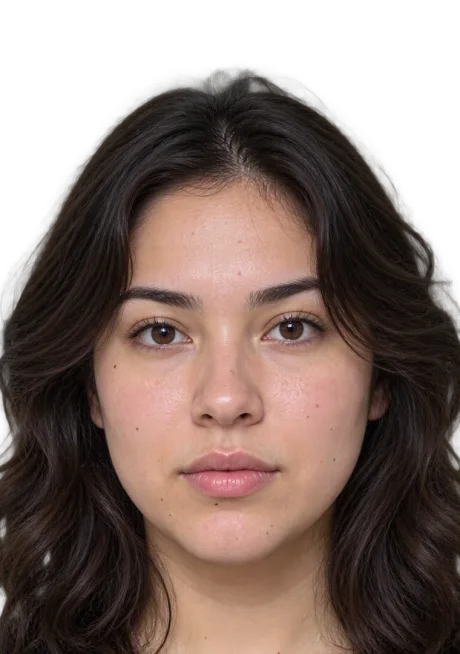
478-point landmark map
Step 1 of 2 · your photo
Add a photo to measure
Face the camera straight on, hair off the face, even light, no tilt.
How it works
Add your photo
Camera or upload — either works.
Mapped in your browser
478 landmarks, entirely on your device.
Your measured result
Numbers and lines drawn on your photo.
On-device · never uploaded
478 landmarks
Free · no signup
The science
How face shape is actually measured
01
Face shape classification comes down to three ratios: face length to cheekbone width, jaw width to cheekbone width, and forehead width to cheekbone width. A long face with similar widths reads oblong; wide cheekbones tapering to a narrow jaw and forehead read diamond; a jaw nearly as wide as the cheekbones with a squared gonial angle reads square; and so on. Stylists estimate these ratios by eye — this tool measures them.
02
It runs a 478-point face-landmark model in your browser, locates the width of your forehead, cheekbones, and jaw plus your face length, and computes the ratios directly. The measurement lines are drawn on your photo so you can see exactly what was measured. Because it is landmark geometry, hairstyle, makeup, and lighting barely affect the result — head tilt does, so face the camera straight on.
03
One caveat worth stating: face shapes are bins imposed on a continuum, and most faces sit between two. The tool tells you your closest shape and the runner-up when it is close, because “oval-leaning-heart” is more honest and more useful for choosing glasses or a haircut than pretending the boundary is sharp.
What your face shape actually decides
Face shape is the input variable for an entire styling stack, which is why "what is my face shape" is worth measuring rather than guessing. Glasses frames counterbalance the face’s dominant quality (angular frames on soft shapes, curves on angular ones). Haircuts add or remove width wherever their volume and cut lines sit. Brows, blush placement, contouring, hair partings, and even earrings each have shape-specific versions of the same counterweight logic — and every one of those tools on this site chains from the measurement this page makes.
The measured ratios matter more than the label: two "round" faces with length-to-width of 1.05 and 1.19 need different amounts of the same corrections. That is why your result shows the three numbers alongside the classification — take them to the styling tools and the recommendations are grounded in your actual geometry.
Why most people guess their face shape wrong
Mirror self-assessment fails for predictable reasons: hair covers the true face outline, the mirror flips left-right asymmetries into unfamiliar positions, and the classic tracing method measures the reflection at whatever distance and angle you happen to stand. Studies of self-classification against measured classification show disagreement rates near half — mostly oval-vs-round and square-vs-rectangle confusions, which happen to be exactly the boundaries where styling advice diverges most.
FAQ
Common questions
What are the 6 face shapes?+
Oval (length noticeably more than cheek width, gentle taper), round (similar length and width, soft jaw), square (wide jaw, angular), heart (wide forehead, narrow chin), oblong (long with even widths), and diamond (wide cheekbones, narrow forehead and jaw).
How do I find my face shape without measuring?+
Pull hair back, face a mirror straight on, and trace your outline on the glass with something erasable — or just upload a photo here and let the landmark model measure the actual ratios in two seconds.
Is my photo stored or uploaded?+
No. Detection runs entirely in your browser; the photo never leaves your device.
What is the rarest face shape?+
Diamond — clearly widest at the cheekbones with a narrow forehead AND narrow jaw — is the least common classification in measurement studies. Oval and round dominate; heart and square sit between.
Can weight change my face shape?+
It changes the soft-tissue reading: weight gain widens cheeks and softens the jaw toward round; loss reveals bone structure. The underlying skeletal ratios stay put, which is why your shape can "change" a category with a significant weight change.
Which face shape suits bangs?+
Fringes shorten the visible face, so they flatter long and oblong shapes and tall foreheads. Round and short faces do better with curtain or side-swept versions that add a diagonal instead of a horizontal line.