
Free · runs on your device
Voice Pitch Test: How Deep Is My Voice?
Read three short lines aloud and this voice test measures your speaking pitch in hertz, names the note it sits on, and tells you how deep your voice is against 135 men and 244 women who read a passage aloud for a published study. It takes under half a minute. Your voice is measured in your browser as you speak and is never recorded or uploaded.
CostFree
TimeUnder 1 min
SignupNone
DataKept on device
Compare my voice with
Read this aloud, in your normal voice
We were away a year ago, on a long road along the river. Every morning we woke early, made a warm meal, and walked in the mild air. In the evening we sat around a lamp, and we laughed and talked until the moon was low.
Your browser asks for the microphone. Your voice is measured in this page as you speak and is never recorded, saved or uploaded. Free, no signup.
Start your glow up
SkinPal on iPhone and Android
Next step · SkinPal app
Your voice is measured. Now work on how you look.
SkinPal does not train voices. It reads your face and skin from a selfie and builds your glow up plan: styling, exercise, daily habits and skin care. It reminds you every day and shows your before and after, week by week.
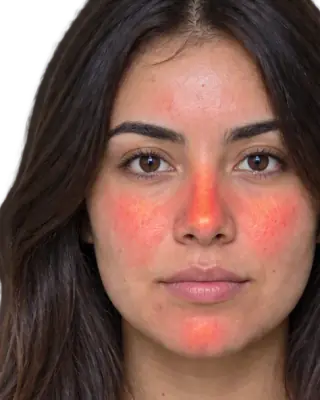
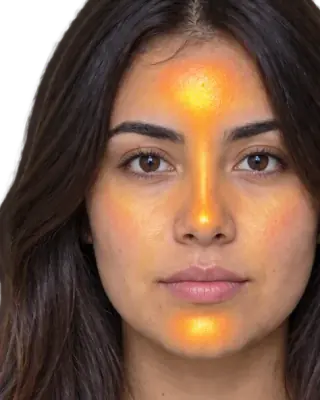

What you unlock in the app
- Full face analysisProportions, symmetry and skin, measured from one selfie
- Full skin report cardSee what's good and what needs work, from acne to skin age
- Heatmaps of your faceSee exactly where redness, oil and breakouts are
- Flare, your AI skin coachAsk anything, get answers based on your own face
- Morning and night routineMade for you, and it changes as you improve
- Ingredient scannerKnow if a product suits you before you buy it
- Progress trackingSee your before and after, week by week
The science
How does the voice pitch test work?
01
Your speaking pitch is the fundamental frequency of your voice: how many times a second your vocal folds open and close while you talk, measured in hertz (Hz). This voice test listens while you read three lines aloud, measures that frequency 50 times a second with YIN, the pitch method published by de Cheveigné and Kawahara in 2002, and keeps only the moments that are clearly voice: a steady, repeating wave loud enough to stand over the room. Breath, consonants, background noise and creaky voice (vocal fry) are left out, as far as a pitch tracker can tell them apart. Your result is the median of what is left, once you have spoken for 8 seconds of voice.
02
Your voice never leaves your device. The microphone feeds the page’s own audio processing in your browser; every fiftieth of a second the page looks at the last tenth of a second of sound, works out its pitch, and overwrites it with the next. Nothing is recorded, saved or uploaded, there is no audio file, and the microphone switches off when the reading ends. Only the numbers stay on the page.
03
The number is then placed among people who did the same thing: 135 men and 244 women aged 18 to 60 who read a passage aloud for a 2022 study of speaking pitch (Leung, Oates, Papp and Chan, Journal of Voice). Their men averaged 115 Hz with a standard deviation of 21, their women 199 Hz with 28. You pick which voices to compare with, men’s or women’s, and see both numbers either way.
How deep is my voice? The voice hertz chart for men and women
Your result names a band from Deep voice to High voice, and each band is a share of speaking voices in the 2022 study: the test works out what share of men (or women) speak higher than you, from the study’s average and standard deviation (read as a bell curve, which is how a published norm is used), and the band follows from that share. The cut-offs are the 15th, 35th, 65th and 85th percentiles, so the five bands hold about 15, 20, 30, 20 and 15% of voices.
| Speaking pitch | Band | What it means |
|---|---|---|
| 93 Hz or lower | Deep voice | Lower than at least 85% of men’s speaking voices |
| 94 to 107 Hz | Deeper than average | Lower than 65 to 84% of men’s speaking voices |
| 108 to 123 Hz | Average pitch | The middle 30%: lower than 35 to 64% of men’s speaking voices |
| 124 to 137 Hz | Higher than average | Lower than only 15 to 34% of men’s speaking voices |
| 138 Hz or higher | High voice | Lower than fewer than 15% of men’s speaking voices |
Voice hertz chart for women
The same five bands for women’s speaking voices, from the same study. A woman with a low voice often reads Deep against women and High against men; the test shows both.
| Speaking pitch | Band | What it means |
|---|---|---|
| 170 Hz or lower | Deep voice | Lower than at least 85% of women’s speaking voices |
| 171 to 188 Hz | Deeper than average | Lower than 65 to 84% of women’s speaking voices |
| 189 to 210 Hz | Average pitch | The middle 30%: lower than 35 to 64% of women’s speaking voices |
| 211 to 228 Hz | Higher than average | Lower than only 15 to 34% of women’s speaking voices |
| 229 Hz or higher | High voice | Lower than fewer than 15% of women’s speaking voices |
Average voice pitch for men and women
Reading aloud, the men in the 2022 study averaged 115 Hz, close to A#2 on a piano, and the women 199 Hz, close to G3. Once age was accounted for, women spoke 76 Hz higher than men, and for every year of age speaking pitch fell by 0.37 Hz, so a 60 year old reads about 15 Hz lower than a 20 year old on average.
Older adults speaking in conversation give a second view. Among 1,154 men and 1,318 women aged 40 to 79 in Leipzig (Berg et al. 2017), men averaged 111.9 Hz and women 168.5 Hz. Men’s pitch rose with age in that group while women’s did not, and the authors note their women spoke six to seven semitones lower than earlier studies had described. A third study points the same way: women around 72 spoke lower than women around 19, while older and younger men did not differ (Goy et al. 2013). If you are over 40, read your band knowing the 2022 norms come from adults 18 to 60.
Deep voice test: what counts as a deep voice?
On this test, a deep voice for a man is 93 Hz or lower: lower than at least 85% of men’s speaking voices. 94 to 107 Hz is deeper than average. For a woman, deep is 170 Hz or lower. These are cut-offs on a published distribution, not a verdict on how your voice sounds: depth is one part of a voice, and resonance, loudness, pace and clarity change how deep it reads to a listener.
Is deeper better? In one listening experiment, women preferred the lower of two men’s voices until the lower one went below about 96 Hz, and from there they preferred the higher one; men preferred the higher of two women’s voices at every pitch tried (Re, O’Connor, Bennett and Feinberg 2012, PLoS ONE). That study used 19 university students and single vowel sounds, so it says something about pitch alone, not about whole voices or people.
Voicecel test: what the word means, and what your Hz says
Voicecel comes from looksmaxxing forums, where it names a man whose high or thin voice is said to cost him in looks. It is forum convention, not research: there is no agreed hertz cut-off, and the forums use it as an insult as often as a description. This page does not call anyone a voicecel.
What a measurement can say: for men, 124 to 137 Hz is higher than average (only 15 to 34% of men speak higher) and 138 Hz or higher is higher than about 85% of men. If you came from the looksmax side, note that voice is not part of a PSL score or the looksmax AI: both read the face from a photo.
Why your voice test reads higher or lower than you expect
Speaking pitch moves through the day and with how you speak, so take two readings on different days before you settle on a number.
- Step 1Volume: louder speech is higher speech. In the Leipzig study, men read 111.9 Hz in conversation, 130.2 Hz in a classroom voice and 175.5 Hz shouting; women 168.5, 198.0 and 246.2. Read at the volume you talk at.
- Step 2Time of day: in a small study of 10 men and 10 women, men’s speaking pitch rose from morning to afternoon while women’s did not change significantly, and the pattern differed from person to person (Garrett and Healey 1987). Compare readings taken at the same time.
- Step 3A cold or a hoarse throat can make your voice read lower for a few days. Read on a normal day.
- Step 4Smoking: current smokers spoke lower than people who never smoked or had quit (Berg et al. 2017).
- Step 5Reading style: a performed, announcer voice reads differently from your talking voice. Read the lines the way you would say them to a friend. The test needs at least 4 seconds of voice for a number, and finishes on its own at 8.
How accurate is an online voice test?
The pitch tracking itself is the accurate part. We ran this page’s exact code on the passage read by 28 of the computer voices built into macOS, from 69 to 297 Hz, and compared it with Praat, the pitch software speech scientists use: the speaking pitch agreed within 0.3 Hz at the median and 6 Hz at most. Most of the gap is which moments count: Praat keeps creaky, falling ends of sentences that this test drops (any moment with an aperiodicity over 0.2), much as the 2022 study separated creak out before averaging.
The microphone matters less than people think. With room noise 15 dB under the voice, a phone-style microphone that cuts everything under 200 Hz (which removes the fundamental of most men’s voices, leaving its overtones), or a voice 30 dB quieter, the readings moved by 5.7 Hz at most. After the first 4 seconds of voice the reading was within 6.3 Hz of the whole reading, after 8 seconds within 4.2 Hz.
What we could not measure: those were synthetic voices, not people. The bigger source of error is you, from day to day and from one way of reading to another, and no tracker removes that. Take two readings, on two days, at the same volume.
Voice test or vocal range test?
This test reads your speaking voice: the pitch you talk at, which is what people mean by a deep or a high voice. Your singing range is a different number, the distance from the lowest to the highest note you can hold. To find it, and the voice type it fits from bass to soprano, use the vocal range test.
FAQ
Common questions
What Hz is a deep voice for a man?+
93 Hz or lower. That is lower than at least 85% of men’s speaking voices in the 2022 study of 135 men reading aloud (average 115 Hz). 94 to 107 Hz is deeper than average, 108 to 123 Hz is the middle 30%, and 138 Hz or higher is higher than 85% of men.
What is the average voice pitch for men and women?+
Reading aloud, 115 Hz for men and 199 Hz for women, in a study of 135 men and 244 women aged 18 to 60 (Leung et al. 2022). In conversation, a study of 1,154 men and 1,318 women aged 40 to 79 measured 111.9 Hz and 168.5 Hz (Berg et al. 2017): older women speak lower than younger women, while men change little.
What is a deep voice for a woman?+
170 Hz or lower is lower than at least 85% of women’s speaking voices in the 2022 study of 244 women reading aloud (average 199 Hz), and 171 to 188 Hz is deeper than average. Compare with men’s voices instead if that is the group you want to sit in: the test shows your place in both.
What is a voicecel?+
Voicecel is a looksmaxxing forum word for a man whose voice is high or thin, by the forum’s reckoning a looks problem. It has no agreed cut-off in hertz and no research behind it: it is forum convention. What this test can tell you is measured: where your speaking pitch sits among adult men, from deep to high, with the hertz for each band.
Is a deeper voice more attractive?+
In one listening experiment, up to a point. Women preferred men’s voices pitched lower, except when the lower voice went below about 96 Hz, where they preferred the higher one; men preferred higher-pitched women’s voices at every pitch tried (Re et al. 2012, 19 university students hearing vowel sounds). It is one small study of single sounds, not whole people.
Does this voice test record my voice?+
No. The pitch is measured in your browser as you speak, 50 times a second, and each slice of sound is overwritten by the next. Nothing is recorded, saved or uploaded, and the microphone turns off when the reading ends.
How accurate is this voice hertz test?+
We checked the tracker against Praat, the standard pitch software in speech science, on the same passage read by 28 computer voices from 69 to 297 Hz: the two agreed within 0.3 Hz at the median and 6 Hz at most. Room noise, a phone-style microphone or a quiet input moved the reading by 5.7 Hz at most. Those were synthetic voices, not people, so your own day-to-day variation is larger than the tracker’s error.
Can you make your voice deeper?+
A little, by habit: louder speech is higher speech, so a relaxed voice at normal volume reads lower than a pushed one. The range your voice can reach is set mostly by the length and mass of your vocal folds; training changes how you use them, not the folds. Forcing your voice well below its natural pitch for long stretches tires it; for a lasting change, a speech-language pathologist or voice coach can train it safely.
Keep going
Vocal range test →
Your lowest and highest held notes, named, and the voice types your range is consistent with, bass to soprano. Nothing is recorded.
Looksmax AI →
Your halo and failo: nine measured features ranked against reference faces of your sex, with the honest lever for each weak one.
PSL score test →
Your measured facial geometry placed on the 1 to 8 PSL scale, with the full tier chart.