
Free · runs on your device
Facial proportions calculator
Your upper, middle, and lower facial thirds measured from landmarks — see which runs long or short against the classical equal-thirds reference, and what styling does with that.
CostFree
TimeUnder 1 min
SignupNone
DataStays on device
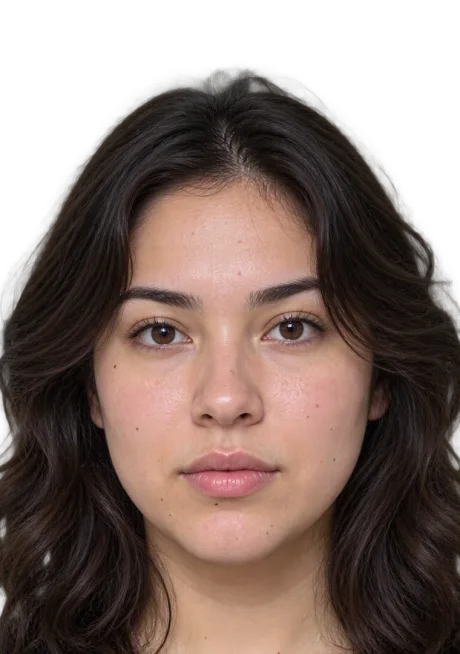
478-point landmark map
Step 1 of 2 · your photo
Add a photo to measure
Face the camera straight on, hair off the face, even light, no tilt.
How it works
Add your photo
Camera or upload — either works.
Mapped in your browser
478 landmarks, entirely on your device.
Your measured result
Numbers and lines drawn on your photo.
On-device · never uploaded
478 landmarks
Free · no signup
The science
Facial thirds: the proportion system that actually gets used
01
The facial thirds divide the face at the brow line and the base of the nose: hairline to brow, brow to nose base, nose base to chin. Classical proportion treats the thirds as equal, and orthodontists and surgeons genuinely use this system — a long lower third, for example, is a real cephalometric finding. This tool measures your thirds from facial landmarks and reports each as a fraction of face height.
02
One measurement honesty note: a landmark model locates your brow and nose base precisely, but your hairline is covered by hair in most photos, so the upper third uses a forehead-top estimate. Your middle and lower thirds are measured accurately; treat the upper third as approximate and pull hair back for the best reading.
03
Equal thirds are the textbook reference, not the human average — most faces run long or short somewhere, and styling already knows what to do with that: fringes and volume placement adjust a long or short upper third, beard length reshapes a short lower third, and brow position choices depend on the middle third. The measurement tells you which lever is yours.
Long midface, short lower third: reading your split
A longer middle third (brow to nose base) is the "long midface" pattern — it reads elegant in profile and slightly serious front-on; brow lifting styling and shorter hairstyles that add width counterbalance it. A longer lower third often tracks with a strong jaw or longer chin and reads mature; beards shorten it visually (paradoxically, by moving the visual chin line up), as do fuller hairstyles. A short lower third reads youthful; lower-face volume (beard length for men, jaw-length hair for anyone) extends it. The upper third is your hairline’s domain — the one third you can literally restyle in minutes, which is why fringe decisions should start from this measurement.
Orthodontics cares about the same splits for function: significantly long or short lower thirds sometimes pair with bite patterns, and vertical proportions are measured before orthognathic treatment. Cosmetically, though, the spread of normal is wide, and the styling counterweights above cover nearly everyone.
FAQ
Common questions
What are the ideal facial thirds?+
The classical reference is three equal thirds — hairline to brow, brow to nose base, nose base to chin. Real faces typically deviate by a few percent in at least one third, and that deviation is normal anatomy, not a flaw.
Why does my upper third measurement seem off?+
Hair. The model estimates your forehead top when the hairline is covered. Pull hair fully back and reshoot for a more accurate upper third.
What is a long midface?+
A middle third (brow to nose base) noticeably taller than the other two. It is one of the traits orthodontic and surgical assessments measure — and cosmetically, brow and hair choices change its visual weight more than people expect.
What are perfect facial proportions?+
The classical canon says equal thirds and a face five eyes wide — references, not requirements. Measured populations spread comfortably around both, and preference research rewards nearness to average more than exactness to canon.
Does a fringe change my facial thirds?+
Visually, completely — a fringe redraws the top boundary of the visible face, shortening a long upper third or overwhelming a short one. It is the cheapest proportion intervention that exists, which is why the measurement is worth knowing before the haircut.