
Free · runs on your device
What eye shape do I have?
Almond, round, upturned, or downturned — measured from your eye landmarks’ height, width, and tilt. The input lash techs and liner tutorials actually use.
CostFree
TimeUnder 1 min
SignupNone
DataStays on device
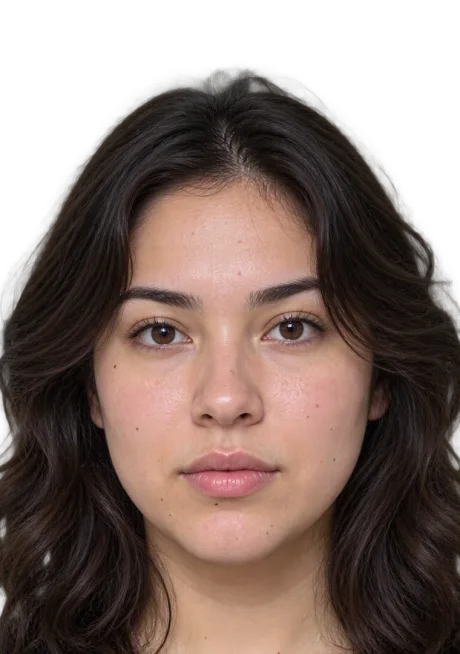
478-point landmark map
Step 1 of 2 · your photo
Add a photo to measure
Face the camera straight on, hair off the face, even light, no tilt.
How it works
Add your photo
Camera or upload — either works.
Mapped in your browser
478 landmarks, entirely on your device.
Your measured result
Numbers and lines drawn on your photo.
On-device · never uploaded
478 landmarks
Free · no signup
The science
How eye shape is classified
01
Two measurements do most of the classifying: the height-to-width ratio of your eye opening, and the tilt of the corner-to-corner axis. A relatively tall, curved opening reads round; a narrower opening with tapered corners reads almond; the tilt then adds upturned or downturned. This tool measures both from eye landmarks — the corners plus the top and bottom of each eye opening — and reports the numbers along with the label.
02
Two shapes need a caveat a landmark model can honestly give: hooded and monolid describe the eyelid above the opening, not the opening itself. A front-facing landmark model measures the opening precisely but sees the lid fold only indirectly, so if your crease is hidden when your eyes are open (hooded) or absent (monolid), combine this measurement with what you see in the mirror — the tool flags when your geometry is consistent with either.
03
Why it is worth measuring at all: eye shape is the input for lash maps, liner styles, and shadow placement. Winged liner behaves completely differently on downturned versus upturned eyes, and lash extensions are literally mapped to the shape — which is why lash techs measure exactly what this tool measures.
Styling by eye shape: the complete cheat sheet
Almond: the reference shape — liner, shadow, and lash styles all work as illustrated on the tutorial. Round: elongate with winged liner extending past the corner, shadow blended outward, cat-eye lash maps; avoid heavy all-around liner that closes the eye further. Upturned: follow the natural line; you can wear the dramatic wing others fake. Downturned: lift — wing angled above the natural corner line, curl and length concentrated just before the outer corner (squirrel map), and skip lower-lash mascara that drags the eye down. Hooded: everything must survive the fold — thin tightlined liner, batwing wings drawn with the eye open, matte shadow above the crease, strong-curl lashes; monolid: gradient vertical shadow, L/M-curl lashes, and liner thickness as the lid’s design line.
FAQ
Common questions
What are the main eye shapes?+
Almond (tapered, moderate height), round (taller, curved), upturned and downturned (by tilt), plus hooded (fold covers the crease) and monolid (no visible crease). The first four are opening geometry, the last two are lid anatomy.
How do I know if my eyes are hooded?+
Look straight ahead in a mirror: if the crease of your eyelid is hidden by skin folding over it, they are hooded. This is about the lid, not the eye opening, so it can combine with any shape — almond-and-hooded is common.
Which eyeliner suits my eye shape?+
Round: a wing extending the outer corner adds length. Downturned: lift the wing above the natural corner line. Upturned: follow the natural line. Hooded: keep liner thin and use the “batwing” technique so it shows when eyes are open.
Can eye shape change with age?+
The opening stays; the lids change — skin laxity creates or deepens hooding for most people from the 40s onward, and the outer corner drifts slightly down. That is why liner techniques that worked at 25 misbehave at 50; re-detect and restyle.
What is the most common eye shape?+
Almond variants dominate globally, with monolids the norm across much of East Asia and hooding increasingly common with age everywhere. Round eyes as a strict classification are rarer than people self-report.