
Free · runs on your device
Ethnicity Guesser: What Ethnicity Do I Look Like?
Upload one photo and this ethnicity guesser shows which of six groups your face looks most like, as a percentage breakdown with a top answer, in a few seconds. It compares your face with 474 labeled reference faces, says how often its answer is right, and runs on your device, so your photo is never uploaded. It reads resemblance in appearance, not DNA or ancestry.
CostFree
TimeUnder 1 min
SignupNone
DataStays on device
On-device face signature
Step 1 of 2 · your photo
Add a photo to guess your ethnicity
Face the camera straight on, even light, no sunglasses or filter. One face works best.
How it works
Add your photo
Camera or upload, either works.
Mapped in your browser
A 128-number face signature, computed entirely on your device.
Your measured result
Numbers and lines drawn on your photo.
On-device · never uploaded
128-number face signature
Free · no signup
Start your glow up
SkinPal on iPhone and Android
Next step · SkinPal app
You don't need surgery to look better.
Mewing and bone smashing won't change your bones. Styling, exercise, better habits and skin care will. SkinPal gives you a plan for all of it, reminds you every day, and shows you the change.
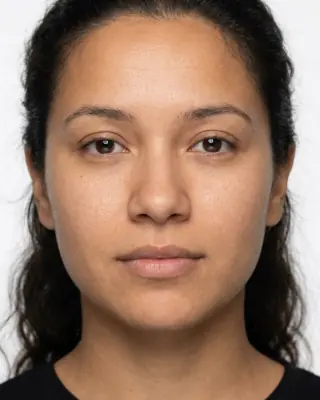
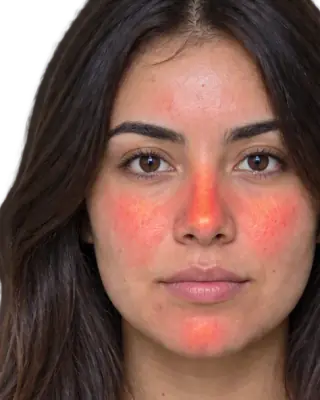
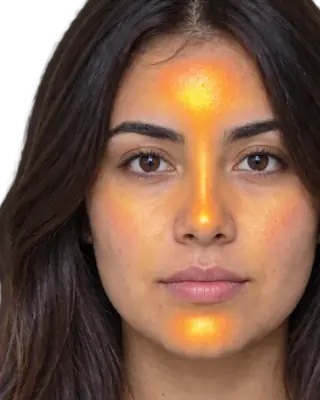
What you unlock in the app
- Full face analysisProportions, symmetry and skin, measured from one selfie
- Full skin report cardSee what's good and what needs work, from acne to skin age
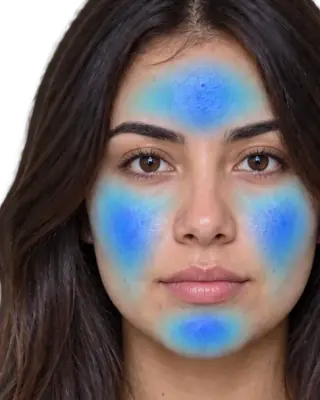
- Heatmaps of your faceSee exactly where redness, oil and breakouts are
- Flare, your AI skin coachAsk anything, get answers based on your own face
- Morning and night routineMade for you, and it changes as you improve
- Ingredient scannerKnow if a product suits you before you buy it
- Progress trackingSee your before and after, week by week
The science
How the ethnicity guesser works
01
The ethnicity guesser turns your photo into a face signature of 128 numbers, the same one the celebrity look alike uses: a face recognition model reads the shape and spacing of your eyes, nose, mouth, jaw and brow and encodes them, in your browser. It describes the whole face rather than one feature; the face shape detector reads the outline on its own.
02
A small model then turns those 128 numbers into six shares that add up to 100%, one per appearance group, and the largest is your top answer. It learned the groups from 474 reference faces: well-known people from every region with a public photo, each labeled by their country and, where Wikidata records it, their ethnic group. People of mixed heritage, and people whose citizenship says nothing about their looks (most Americans, Canadians and Australians with no recorded ethnic group), were left out, so no label contradicts what Wikidata records. Your browser receives only the model's weights, about 7 KB: no reference photo, name or face signature.
03
It does not read skin colour. Tested on the same faces, adding cheek skin colour did not make the guess more accurate, because lighting and makeup change skin colour in photos more than ancestry does. To measure your tone itself, use the skin tone finder or the Monk skin tone scale.
What ethnicity do I look like? Reading your result
Your result lists all six groups with a share each, largest first. The top share answers "what ethnicity do I look like": the group whose reference faces yours is closest to. The second share matters too: a face at 55% South Asian and 30% Middle Eastern & North African sits between the two, and the result says so.
How sure to be depends on the top share. Every reference face was read by a model that had never seen that person, and the table shows how often each kind of reading matched the face’s own group.
| Top share | Reading | Share of faces | Top answer right | Right group in top two |
|---|---|---|---|---|
| 70% or more | Clear match | 44% | 92% | 96% |
| 50 to 69% | Leaning | 24% | 53% | 75% |
| Under 50% | Mixed | 32% | 40% | 64% |
A mixed reading means no group stands out in that photo. Try a second photo in even light: if the same two groups lead again, your face sits between them.
What race do I look like? The six groups
People search for an ethnicity guesser, a race guesser or "what race do I look like", and a photo answers all three in one sense only: which group of faces yours resembles. These are the six groups, how many reference faces each has, where they come from, and how often a face from each group got its own group as the top answer.
| Group | Reference faces | Where they come from | Top answer right |
|---|---|---|---|
| Black / African | 124 | Africa (Nigeria, Ghana, South Africa, Kenya, Ethiopia and more) and the African diaspora in the US, the Caribbean and Europe | 83% |
| East & Southeast Asian | 76 | China, Japan, South Korea, Taiwan and Hong Kong, with a few from Thailand, Indonesia, Malaysia and the Philippines | 93% |
| White / European | 79 | Europe, plus Americans, Canadians and Australians whose recorded ancestry is European | 57% |
| Latin American | 61 | Brazil, Argentina, Mexico, Colombia, Uruguay, Cuba and the rest of Latin America, plus Latino Americans | 31% |
| Middle Eastern & North African | 66 | Turkey, Iran, Israel, Lebanon, Egypt, Morocco, Algeria, Tunisia and the rest of the region | 33% |
| South Asian | 68 | India, Pakistan, Bangladesh, Sri Lanka and Nepal | 77% |
Six groups, not seven. The FairFace dataset, a common benchmark for face classifiers, uses seven race groups and splits Southeast Asian from East Asian (Kärkkäinen and Joo, WACV 2021). This reference set has only 9 Southeast Asian faces, too few to learn as a group, and 7 of the 9 read East Asian when held out, so the two share a group. Africa and the African diaspora share one too: kept apart, the model told them apart only about half the time.
How accurate is an AI ethnicity guesser?
Measured, not claimed: each of the 474 reference faces was read by a model trained without that person, from the same face signature your browser computes. The top answer matched the face’s group 66% of the time, and the right group was in the top two 81% of the time. Guessing at random would be right one time in six, 17%.
Accuracy depends on the group. East & Southeast Asian faces got their own group 93% of the time, Black / African 83%, South Asian 77% and White / European 57%. Latin American (31%) and Middle Eastern & North African (33%) faces are the hardest: 20 of the 61 Latin American faces read White / European and 15 read Middle Eastern, and 16 of the 66 Middle Eastern faces read South Asian and 15 read White / European. Both regions hold a wide range of looks, and many of their faces overlap with the European reference faces.
A second photo shows how stable an answer is. For 31 of the people there was a second, different photo: its top group matched their own group for 20 of them and matched the first photo’s answer for 24. If your two photos disagree, the reading is closer to mixed than either one says.
Guess my ethnicity: how to take the test
The test takes a few seconds and needs one clear photo of your face from the front. The photo is read in your browser and never uploaded.
- Step 1Take or upload a front-facing photo: camera at eye level, about arm’s length away, head straight, even light on both sides of your face, no sunglasses, filter or beauty mode.
- Step 2Wait while the face model loads (about 7 MB, the first time only) and reads your face signature.
- Step 3Read your share for each of the six groups, your top group and how clear the reading is.
Filters and beauty modes reshape the face the model reads, and strong light from one side changes it too. If two photos disagree, trust the one taken in even daylight.
What nationality do I look like?
No photo can show a nationality. Citizenship is a passport, not a face, and most countries hold people of several ancestries: the US citizens among the reference faces fall in all six groups, and the British and French citizens in five each.
What a photo can tell you is the region of the world whose faces yours most resembles, which is what the question usually means, and that is what this tool gives you. For a named person instead of a region, the celebrity look alike matches your face with 600 well-known people from every region.
What is my ethnicity? A photo vs a DNA test
A photo answers what you look like. Your ethnicity in the full sense is ancestry, language and culture, and ancestry takes records or a DNA test: DNA services compare your genome with reference populations and report percentages by region.
The two answers often differ, and both can be right. Facial appearance is shaped by a small part of your genome, so two siblings with the same ancestry can read differently, and a person with roots in three regions can read clearly as one of them. Use this tool for "what do people see?" and a DNA test for "where are my ancestors from?".
FAQ
Common questions
What ethnicity do I look like?+
Upload a clear, front-facing photo and the ethnicity guesser shows which of six groups your face resembles most, with a share for each: Black / African, East & Southeast Asian, White / European, Latin American, Middle Eastern & North African, South Asian. A top share of 70% or more is a clear match, and clear matches were right 92% of the time when tested on 474 faces.
Can AI tell my ethnicity from a photo?+
It can tell which group your face resembles, not your ancestry. Tested on 474 faces it had never seen, this tool's top answer matched the face's group 66% of the time, against 17% by chance, and 92% of the time when the reading was clear. It is weakest on Latin American and Middle Eastern faces, which often read White / European.
Is ethnicity the same as race?+
No. Race usually means groups defined by physical traits such as skin colour and facial features; ethnicity means shared ancestry, culture and language. A photo only shows appearance, so this tool reports appearance groups, which is closer to what most people mean by race.
How do I find out what ethnicity I am for free?+
For what you look like, a free photo tool like this one answers in seconds. For your actual ancestry, start with family, birth and census records, many of them free to search; a DNA test is the paid step that compares your DNA with reference populations.
Is my photo uploaded?+
No. The face model and the small group model download to your browser and the reading happens there. Your photo, your face signature and your result never leave your device.
What are the main ethnic groups?+
There is no single official list. Face research often uses seven groups: White, Black, East Asian, Southeast Asian, Indian, Middle Eastern and Latino, as in the FairFace dataset (Kärkkäinen and Joo, 2021). Censuses use their own lists. This tool uses six, with East and Southeast Asian together, because its reference set has too few Southeast Asian faces to learn them apart.
Can I guess my nationality from my face?+
Not a country: nationality is citizenship, and most countries have people of several ancestries. The closest a photo gets is a region, which this tool gives you, and a named lookalike, which the celebrity look alike finds among 600 well-known people.
Why did I get a different ethnicity than I am?+
Usually because your face sits close to another group's reference faces, which happens more for some groups than others: in testing, 33% of Latin American faces read White / European and 24% of Middle Eastern faces read South Asian. Lighting, angle, filters and expression move the result too, so try a second photo in even light.
Is a race guesser the same as an ethnicity guesser?+
For a photo, yes: both ask which group a face looks like, and this tool answers both with the same six groups. Some sites called race guessers are games where you guess other people’s ethnicity from photos; this one reads your own face.
Is this the same as the ChatGPT ethnicity guesser?+
No. ChatGPT ethnicity guessers are custom GPTs: your photo goes to OpenAI and a language model describes what it sees. This tool never uploads your photo, compares your face signature with 474 labeled reference faces on your device, and tells you how often its answer is right.
Keep going