
Free calculator · no signup
FFMI Calculator: Your Fat-Free Mass Index and Natural Limit
Enter your height, weight and body fat to get your fat-free mass, FFMI and normalized FFMI, and see where you sit on the published charts for men and women, up to the natural limit of 25 found in drug-free male lifters. No body fat number? Estimate it with a tape measure. It takes under a minute.
CostFree
TimeUnder 1 min
SignupNone
DataKept on device
Sex
Units
Height
cmWeight
kgBody fat
Your FFMI shows here as soon as height, weight and body fat are in.
Start your glow up
SkinPal on iPhone and Android
Next step · SkinPal app
Your FFMI covers the body. SkinPal covers the face.
Lower body fat shows your jaw; skin, hair and grooming do the rest. SkinPal builds your glow up plan for all of it: exercise, daily habits, styling and skin care, reminds you every day, and shows you the change.

What you unlock in the app
- Full face analysisProportions, symmetry and skin, measured from one selfie
- Full skin report cardSee what's good and what needs work, from acne to skin age
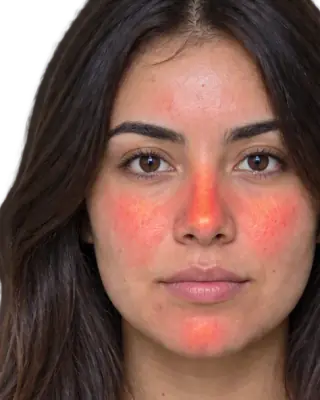
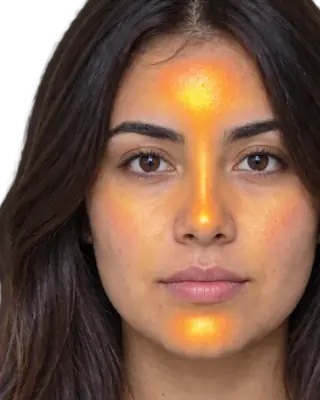
- Heatmaps of your faceSee exactly where redness, oil and breakouts are
- Flare, your AI skin coachAsk anything, get answers based on your own face
- Morning and night routineMade for you, and it changes as you improve
- Ingredient scannerKnow if a product suits you before you buy it
- Progress trackingSee your before and after, week by week
The science
What is FFMI?
01
FFMI, the fat-free mass index, is your fat-free mass in kilograms divided by your height in meters squared. Fat-free mass is everything in your body that is not fat: muscle, bone, organs and water. Dividing by height squared works the way BMI does, so people of different heights can be compared, but because the fat comes out first, FFMI measures how much muscle you carry instead of how heavy you are.
02
The index was proposed by VanItallie and colleagues in 1990 as a nutrition measure (American Journal of Clinical Nutrition). It became the lifting world’s number in 1995, when Kouri, Pope and colleagues at McLean Hospital measured 157 male athletes, 83 who used anabolic steroids and 74 who did not, and found that the drug-free men went up to a normalized FFMI of 25.0 and no higher (Clinical Journal of Sport Medicine). That is where the natural limit of 25 comes from.
03
Normalized FFMI adds 6.1 × (1.8 − your height in meters). Raw FFMI runs slightly higher in tall people at the same build, so the correction restates every result as if you were 1.8 m tall: it adds a little below 180 cm and takes a little away above it. That is the number to compare with the limit of 25 at any height.
How to calculate FFMI: the formula and a worked example
Three steps, with weight in kilograms and height in meters. If you enter pounds and feet, the calculator converts them first: 1 lb is 0.4536 kg and 1 inch is 2.54 cm. Here is a man 178 cm (5 ft 10 in) tall who weighs 82 kg (181 lb) at 18% body fat.
- Step 1Fat-free mass = weight × (1 − body fat ÷ 100). 82 × 0.82 = 67.2 kg.
- Step 2FFMI = fat-free mass ÷ height². 67.2 ÷ (1.78 × 1.78) = 67.2 ÷ 3.17 = 21.2.
- Step 3Normalized FFMI = FFMI + 6.1 × (1.8 − height). 21.2 + 6.1 × 0.02 = 21.3.
His 21.3 is in the Trained band for men, 20 to 21.9. At the drug-free limit of 25 he would carry 78.8 kg of fat-free mass at the same height, 11.6 kg more than today. Each point of body fat he is off by moves his FFMI by 0.26, which is why the body fat number matters more than any other input.
Most calculators use the 6.1 in step 3, and so does this one; the abstract of Kouri’s paper prints 6.3. From 150 to 210 cm the two versions differ by 0.06 at most, which never changes a band.
FFMI chart for men: what is a good FFMI?
A good FFMI for a man who lifts is 20 or more: past where most men land and level with the average college athlete. 22 to 25 takes years of serious training, and 25 is the highest any drug-free athlete reached in Kouri’s study. The men’s chart reads normalized FFMI, the number Kouri’s limit and the athlete studies use.
| Normalized FFMI | Band | What it means, and the source |
|---|---|---|
| Under 17 | Low | Less fat-free mass than most men carry. Under 17 is the cutoff for low fat-free mass in men in the ESPEN malnutrition criteria (Cederholm et al. 2015). |
| 17 to 19.9 | Typical | Where most men land. Men with a normal BMI measured 16.7 to 19.8 among 2,986 Swiss adults, median 18.9 at ages 18 to 34 (Kyle et al. 2003; Schutz et al. 2002). |
| 20 to 21.9 | Trained | Regular training shows: level with the average college athlete. 596 college athletes across 10 men’s sports averaged 21.5 (Magee et al. 2024). |
| 22 to 25 | Advanced | Years of serious training, up to the highest drug-free value Kouri measured. Kouri’s 74 drug-free athletes reached up to 25.0 (Kouri et al. 1995); 235 college football players averaged 23.7 (Trexler et al. 2017). |
| 25.1 to 28 | Past the natural limit | Above every drug-free athlete in Kouri’s study. Rare, and not proof of steroids. 20 pre-steroid Mr. America winners (1939 to 1959) averaged 25.4 (Kouri et al. 1995), and 62 of 235 college football players scanned by DXA were above 25 (Trexler et al. 2017). |
| Over 28 | Beyond the athlete range | Above 97.5% of the male college athletes measured. The 97.5th percentile was 28.1 in college football (Trexler et al. 2017) and 28.3 across 10 sports (Currier et al. 2019). Some steroid users in Kouri’s study passed 30. |
The two general-population bands come from bioimpedance in Swiss adults, the athlete bands from DXA and air displacement scans of college athletes, and the limit from Kouri’s skinfold measurements. A number from one method is not a perfect match for another, so read a result near an edge as either side of it.
FFMI for women: the female FFMI chart
Women carry less fat-free mass for their height, and the gap is about 3.5 points both in the general population (median 18.9 in men, 15.4 in women; Schutz et al. 2002) and among college athletes (21.5 and 17.9; Magee et al. 2024). The men’s chart does not apply, and neither does Kouri’s 25: it was measured in men only.
The women’s chart reads FFMI itself, not the normalized number. The study of 372 female college athletes found that adjusting for height made no significant difference (Harty et al. 2019), and the 1.8 m in the normalization is a man’s reference height, which would add about 0.9 to a woman of 165 cm for no reason. The calculator still shows your normalized number for comparison with other calculators.
| FFMI | Band | What it means, and the source |
|---|---|---|
| Under 15 | Low | Less fat-free mass than most women carry. Under 15 is the cutoff for low fat-free mass in women in the ESPEN malnutrition criteria (Cederholm et al. 2015). |
| 15 to 16.9 | Typical | Where most women land. Women with a normal BMI measured 14.6 to 16.8 among 2,649 Swiss adults, median 15.4 at ages 18 to 34 (Kyle et al. 2003; Schutz et al. 2002). |
| 17 to 18.9 | Trained | Regular training shows: level with the average female college athlete. 1,365 college athletes across 8 women’s sports averaged 17.9 (Magee et al. 2024); 266 in a second sample averaged 16.9 (Blue et al. 2019). |
| 19 to 23.9 | Advanced | More than the average female college athlete, up to the top 2.5% of them. 372 female college athletes averaged 18.8, rugby players highest at 20.1, and the 97.5th percentile was 23.9 (Harty et al. 2019). |
| Over 23.9 | Beyond the athlete range | Above 97.5% of the female college athletes measured, the closest published figure to a natural limit for women. The 97.5th percentile of 372 female college athletes was 23.9 (Harty et al. 2019); the highest of 266 in a second study was 25.5 (Blue et al. 2019). Kouri measured men only. |
The natural FFMI limit: is 25 really the max?
Kouri’s 25 is a real finding from a small sample. The 74 drug-free men were athletes recruited at gyms, and their body fat was estimated with skinfold calipers. None passed a normalized FFMI of 25.0, while many of the 83 steroid users did and some passed 30. The authors called the finding preliminary.
Larger samples put the ceiling higher. The 20 pre-steroid Mr. America winners in the same paper, from 1939 to 1959, averaged 25.4. DXA scans of college athletes put the 97.5th percentile at 28.1 among 235 football players, where the highest was 31.7 in a lineman (Trexler et al. 2017), and at 28.3 among 209 athletes from 10 sports (Currier et al. 2019).
What that means for you: a normalized FFMI above 25 is rare in lean drug-free lifters, possible in big athletes, and the first thing to recheck is your body fat number. Read 5 points too low, it adds about 1.3 to the FFMI of an 82 kg man at 178 cm, enough to cross the line on its own.
No body fat %? Estimate it with a tape measure
The calculator’s tape option uses the US Navy circumference method (Hodgdon and Beckett, Naval Health Research Center, 1984): your height and neck and waist for men, plus hips for women, give your body density and from it your body fat. Its standard error against underwater weighing was 3.5 points of body fat in men and 3.7 in women, so the result shows the FFMI range that error spans.
- Step 1Neck: just below the Adam’s apple, the tape sloping slightly down toward the front, snug but not pressing.
- Step 2Waist: men at the navel, women at the narrowest point between ribs and hips. Stand relaxed and measure after breathing out.
- Step 3Hips, women only: around the widest part of the buttocks, feet together.
- Step 4Take each measurement twice and use the average, and measure your height without shoes.
The worked example man, with a 38 cm neck and an 87 cm waist, estimates at 18.0% body fat. If you can book a DXA scan, use its number instead: it is the method most of the athlete studies above used.
FFMI vs BMI
BMI is your weight divided by your height squared, so it cannot tell muscle from fat. The worked example man has a BMI of 25.9, which the BMI scale calls overweight, and a normalized FFMI of 21.3, which says trained. FFMI takes the fat out first, which makes it the better number for anyone who lifts. It needs one more input, your body fat, and that input is also its main source of error.
How to raise your FFMI, and what lower body fat shows
Only fat-free mass raises FFMI, and at 178 cm each kilogram of it adds 0.3. That makes it a slow number: compare readings months apart, taken the same way, with the same body fat method.
Losing fat does not raise FFMI. If you keep your muscle, your FFMI holds while your body fat falls, and that is what changes your face: fat under the chin and along the jaw is what hides the jaw corner. If your jawline analysis reads soft while your gonial angle is in the typical range, body fat is the lever, not bone.
FAQ
Common questions
What is a good FFMI?+
For a man, 20 or more is good: above the 17 to 19.9 where most men land, and level with the average college athlete at 21.5. 22 to 25 is advanced, and 25 is the highest any drug-free athlete reached in Kouri’s 1995 study. For a woman, 17 or more is good, 19 or more is advanced, and 23.9 is the top 2.5% of female college athletes.
How rare is a 25 FFMI?+
Rare in lean drug-free lifters: none of the 74 drug-free athletes in Kouri’s study passed a normalized 25.0, and men with a normal BMI measure 16.7 to 19.8. It is more common in heavy college athletes scanned by DXA: 62 of 235 football players were above 25 (Trexler et al. 2017).
Is a 26 FFMI possible naturally?+
Yes, but it is past the limit Kouri measured. The 20 pre-steroid Mr. America winners in the same paper averaged 25.4, and the 97.5th percentile of male college athletes is about 28. Before reading anything into a 26, check your body fat number: reading it 5 points too low adds about 1.3 to the FFMI of an 82 kg man at 178 cm.
What is the natural FFMI limit for women?+
There is no female 25, because Kouri measured men only. The closest published figure is 23.9, the 97.5th percentile of 372 female college athletes scanned by DXA (Harty et al. 2019). Women with a normal BMI measure 14.6 to 16.8, and female college athletes average about 18.
Is FFMI the same as BMI?+
No. BMI divides your whole weight by your height squared, so muscle and fat count the same. FFMI divides only your fat-free mass. A man of 82 kg at 178 cm and 18% body fat has a BMI of 25.9, overweight on the BMI scale, and a normalized FFMI of 21.3, which is trained.
How do I calculate FFMI without knowing my body fat?+
Estimate your body fat first. This calculator’s tape option uses the US Navy method: height, neck and waist for men, plus hips for women. Its standard error is about 3.5 points of body fat, which moves the FFMI of an 82 kg man at 178 cm by about 0.9 either way, and the result shows that range.
How much lean mass should I have?+
Multiply an FFMI by your height in meters squared. At 178 cm, the 17 to 19.9 most men land in is 54 to 63 kg of fat-free mass, and the drug-free limit of 25 is about 79 kg. At 165 cm, the 15 to 16.9 most women land in is 41 to 46 kg.