
Free · runs on your device
Gonial angle calculator
Measure the angle where your jaw turns up toward your ear, left and right, from one side-facing photo. Most adults fall between 110° and 130°.
CostFree
TimeUnder 1 min
SignupNone
DataStays on device
478-point landmark map
Step 1 of 2 · your photo
Add a photo to measure
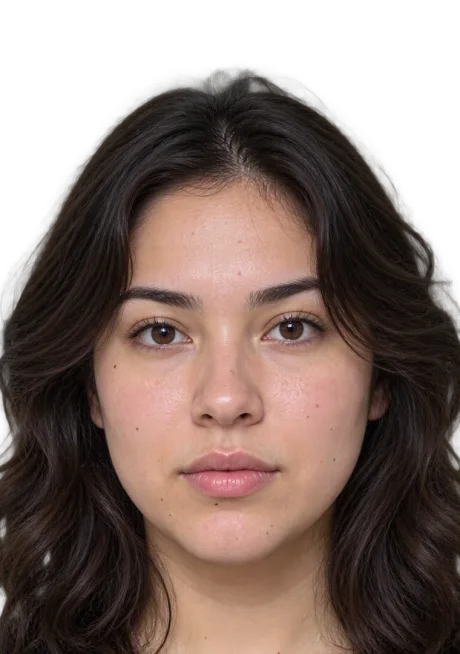
Face the camera straight on, hair off the face, even light, no tilt.
How it works
Add your photo
Camera or upload — either works.
Mapped in your browser
478 landmarks, entirely on your device.
Your measured result
Numbers and lines drawn on your photo.
On-device · never uploaded
478 landmarks
Free · no signup
The science
What your gonial angle number means
01
The gonial angle is the corner where the horizontal body of your jaw turns up toward the ear. Most adults measure between 110 and 130 degrees. Below about 115 the jaw reads square and defined. Between 115 and 130 it reads normal, which covers the majority of faces. Above about 135 the corner is soft enough that the jaw and neck start to blend in profile, and that is the point where people notice it and where it costs definition.
02
A left-right difference under 3 degrees is universal and invisible. Between 3 and 6 it is measurable but rarely noticed by anyone else. Past roughly 6 degrees the asymmetry becomes visible in a straight-on photo, and if it appeared recently rather than being lifelong, that is a reason to see a clinician, since bite problems and jaw joint issues can produce it.
03
The angle itself is bone, and no exercise, chewing, or posture changes it. What changes how it looks is the tissue over it: body fat, water retention, and masseter bulk. If your angle is inside the normal range and your jaw still reads soft, the lever is almost always body fat, not bone. If the angle is genuinely above 135 and it bothers you, the honest options are surgical, and a maxillofacial consult is the only place that conversation is worth having.
FAQ
Common questions
What is a good gonial angle?+
There is no clinical target, but there is a readable range. 110 to 130 degrees is typical. Under 115 reads square, over 135 reads soft enough that definition is visibly lost. Most people asking this question measure inside the normal band and are seeing body fat, not bone.
How much jaw asymmetry is normal?+
Under 3 degrees between sides is universal. 3 to 6 is measurable and usually unnoticed. Over about 6 degrees is visible, and if it is new rather than lifelong it is worth a clinician looking at bite and jaw joint.
Can I change my gonial angle?+
Not the bone, and not with exercises, gum, or posture. You can change what sits on top of it. Losing body fat is the single lever that reliably sharpens a jaw whose angle is already normal. For an angle genuinely above the range, surgery is the only real option.
Why does my measurement change between photos?+
Head tilt and camera height. Raising your chin flattens the angle; shooting from below does the same. Shoot level, at eye height, hair off the jaw, and compare like with like. The tool is only as honest as the photo.