Free · runs on your device
Hairline Test: Mature or Receding, and Your Hairline Type
Upload one front photo with your hair pushed back and this hairline test traces your hairline, names its type (straight, rounded, bell-shaped, M-shaped, widow’s peak or uneven), tells you whether it reads mature or receding on the Norwood scale, and measures how high it sits against your middle third. It takes under a minute, and your photo is never uploaded.
CostFree
TimeUnder 1 min
SignupNone
DataStays on device
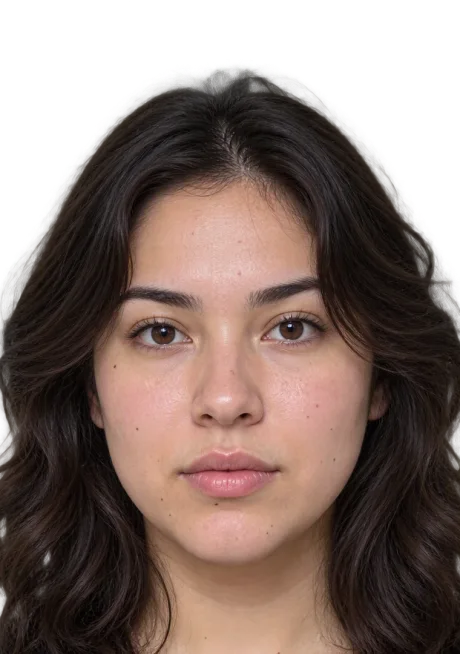
Hairline + landmark map
Step 1 of 2 · your photo
Add a photo with your hair pushed back
Face the camera straight on, camera at eye level, hair pushed or tied back off your forehead and temples, no hat. Even light from the front.
How it works
Add your photo
Camera or upload, either works.
Mapped in your browser
Your hairline traced across your forehead, its type and height measured, entirely on your device.
Your measured result
Numbers and lines drawn on your photo.
On-device · never uploaded
Hairline traced
Free · no signup
The science
What is a hairline test?
01
A hairline test reads the front edge of your hair from a photo and answers three questions: what shape your hairline is, whether it is a mature hairline or a receding one, and how high it sits on your forehead. This one measures all three from one front photo with your hair pushed back, in your browser.
02
The shape is one of six hairline types: straight, rounded, bell-shaped, M-shaped, widow’s peak or uneven, each named by a measured cut-off on the traced line. Mature or receding uses the Norwood scale, the standard grading of male pattern hair loss: stage 2 is the mature hairline, stage 3 is the first stage Norwood counted as balding (Southern Medical Journal, 1975). Height is your forehead against your own middle third, so the size of your face and of the photo do not change it.
03
It is a cosmetic measurement, not a diagnosis. It cannot see your crown, single hairs or shedding, and one photo shows where your hairline is, not whether it is moving.
How the hairline test reads your photo
Two models run in your browser. A face landmark model finds 478 points on your face, which give your brow line and your middle third: the height from between your brows (the glabella) to the base of your nose. A segmentation model marks every pixel as hair, skin, background or clothing. The test then walks straight up your forehead from just above the brows in 47 columns, from beyond one outer eye corner to beyond the other, and records where hair starts in each. That line is your traced hairline, drawn on your photo.
Everything is measured in middle thirds, so a close selfie and a photo from across the room read the same. Forehead height is the distance from the glabella up to the hairline at the middle of your forehead. Temple recession is how much higher your hairline sits at the temples than in the middle. The hairline type comes from the shape of the whole traced line.
We tested it on 795 photos of public figures. 679 had a face the landmark model found, and 317 of those had a hairline the test could read. The rest it turned down with a reason instead of guessing: a turned head (190), hair across the forehead (81), a fringe (47), a hat or headband (15), a shaved or bald scalp (13), a tilted head (12), hair and skin that did not separate (3) and a cropped head (1).
Mature hairline vs receding hairline
A mature hairline moves back a little in early adulthood, mostly at the temples, and then holds. A receding hairline keeps moving. The test places your hairline on the Norwood scale with the same cut-offs as our Norwood scale test, from your temple recession and your forehead height, whichever reaches further:
| Reading | Cut-off | What it means |
|---|---|---|
| Not receding | Temples under 0.12 and forehead under 1.00 | Norwood stage 1: little or no recession at the temples. |
| Mature | Temples from 0.12, or forehead from 1.00 | Norwood stage 2, the mature hairline. Norwood did not count it as balding. |
| Receding | Temples from 0.22, or forehead from 1.12 | Norwood stage 3, the first stage Norwood counted as balding. |
| Receded past stage 3 | Forehead from 1.35, or temples from 0.22 with forehead from 1.00 | Stage 4 or beyond from the front. The crown decides which, and a front photo cannot see it. |
The middle half of the 166 men in our reference photos read a forehead of 0.81 to 1.01 middle thirds and temples of -0.01 to +0.08. Hair clinics often describe a mature hairline as sitting about one finger width above the highest forehead crease. Jeff Donovan, a board-certified dermatologist who treats only hair loss, puts normal maturation at about one finger breadth, and about two at the temples, with more suggesting pattern hair loss. That is a rule of thumb, not a published measurement, and it needs the crease that shows when you raise your brows, so the test uses Norwood’s depth instead.
One photo shows where your hairline is, not whether it is moving. The reliable test is time: take the same photo every few months, or run a photo from a few years ago, and compare the readings.
Hairline types: the six shapes and how each is measured
Hairline studies sort front hairlines into a handful of shapes: rectangular or straight, round, M-shaped, bell-shaped and triangular, with the widow’s peak recorded on its own (Sirinturk et al., Surgical and Radiologic Anatomy, 2017; Kashiyama et al., Plastic and Reconstructive Surgery Global Open, 2021). Those studies sorted by eye. The test names six types from the traced line, each with a measured cut-off in middle thirds, checked in this order:
| Type | What it looks like | Measured cut-off |
|---|---|---|
| M-shaped | Higher at both temples than in the middle. | Temples 0.10 or more above the middle on average, and at least 0.03 on each side. |
| Widow’s peak | A V point in the middle. | The middle dips 0.04 or more below the hairline on either side of it. |
| Uneven | Higher on one side than the other. | Temples 0.15 or more apart, or the two halves 0.10 apart on average. Read only when you face the camera within about 7 degrees. |
| Bell-shaped | Rounded on top, steep at the sides. | Sides 0.06 or more below the middle, reaching within 0.35 of the brows by the outer eye corners. |
| Rounded | One arch, lower toward the temples. | Sides 0.06 or more below the middle. |
| Straight | Level across the forehead. | None of the above: the sides within 0.06 of the middle. |
An M-shaped hairline can also have a widow’s peak, and the result says so. On 202 reference photos we could judge by eye, sorted blind to the numbers, the test named the same type for 130 (64%). Most disagreements were straight against rounded, which is a matter of degree.
In our reference photos, men read 63% straight, 14% M-shaped, 14% rounded, 4% widow’s peak, 4% uneven and 1% bell-shaped; women read 45% rounded, 30% straight, 12% bell-shaped, 9% uneven, 2% widow’s peak and 1% M-shaped. Studies that sort by eye in person find more M-shaped men: 42.6% of 122 Japanese men (Kashiyama, 2021) and 46% of young Turkish men (Sirinturk, 2017). Two things explain the gap. A mild M below 0.10 reads straight here, and many of the women in our photos wore their hair down over the temples, which reads rounded or bell-shaped: 12 of the 19 bell-shaped readings were hair worn down. Push your hair back or tie it for a true reading.
For cuts that suit your hairline and face, the hairstyle finder matches styles to your face shape, and the hair parting finder picks the side to part on.
Straight
Level across the forehead.
Men 63% · women 30%
Rounded
One arch, lower toward the temples.
Men 14% · women 45%
Bell-shaped
Rounded on top, steep at the sides.
Men 1% · women 12%
M-shaped
Higher at both temples than the middle.
Men 14% · women 1%
Widow’s peak
A V point in the middle.
Men 4% · women 2%
Uneven
Higher on one side.
Men 4% · women 9%
Widow’s peak: what it is and how common it is
A widow’s peak is a V-shaped point at the middle of the hairline. Studies report very different shares: 81% of 360 women measured at a hair salon had one (Nusbaum and Fuentefria, Dermatologic Surgery, 2009), against 32.8% of men and 29.6% of women in a Japanese study (Kashiyama, 2021).
This test finds the peaks deep enough to trace in a photo: 0.04 middle thirds or more. It found one in 9% of the men and 2% of the women in our reference photos. Of the 19 photos at that cut-off, 14 showed a clear peak by eye; the other 5 were a strand or a gap at a part, curls, or a bald or shaved head. A small peak below the cut-off reads as the hairline around it.
Textbooks often call the widow’s peak a single dominant gene. Biologist John McDonald of the University of Delaware looked for the evidence and found no study showing that (Myths of Human Genetics). A widow’s peak is also not a sign of hair loss: it is a shape, and a receding hairline is a change.
Am I balding? What a hairline test can and cannot tell
By Norwood’s definition you are balding from stage 3, which this test reads at temple recession of 0.22 or a forehead of 1.12. It is common: in a community sample of men aged 18 to 49, 42% were at stage 3 or higher, from 16% of men aged 18 to 29 to 53% of men aged 40 to 49 (Rhodes et al., Dermatologic Surgery, 1998). Of the 166 men in our reference photos, 21 read stage 3 or beyond from the front.
A front photo misses the crown. Hair loss that starts at the crown can be well along while the front still reads not receding, so if your crown looks thin from above, that matters more than this reading. Shedding, a widening part and finer hairs at the front edge are also outside what a photo at this size can measure. A dermatologist can examine the scalp, crown included, and tell pattern hair loss from other causes. The Norwood scale test shows the full stage chart.
How high should your hairline be? Forehead height
The test measures your forehead from the glabella, between your brows, up to the middle of your hairline, and divides it by your middle third, from the glabella to the base of your nose. The classical canon of proportions has the thirds equal, a forehead of 1.00. Real foreheads mostly sit a little lower: the middle half of men in our reference photos read 0.81 to 1.01, and of women 0.84 to 0.98. In centimeters, one study of 360 women measured 5.5 cm on average from mid-eyebrow to the middle of the hairline (Nusbaum and Fuentefria, 2009).
A high reading and a receded hairline look the same in one photo. Your history tells them apart: a high hairline you have always had, with even edges and no M, is the shape of your forehead. Finger widths, the usual way forums measure foreheads, vary from hand to hand, which is why the test uses your own middle third instead. The facial thirds tool compares all three thirds of your face, and the face shape detector reads its overall shape.
Hairline test for women
The hairline type and forehead height describe a woman’s hairline as well as a man’s, and the result card switches to the ranges measured on the 137 women in our reference photos. The Norwood stage does not apply: it describes men’s hairlines. In women, pattern hair loss usually keeps the front hairline and thins across the top along the part, which Erich Ludwig graded in 1977 (British Journal of Dermatology), and a front photo with the hair pushed back cannot see it. A hairline that has moved back can have other causes too, such as hair pulled tight for years (traction alopecia), which a dermatologist can tell apart.
Hairline test: how to take the photo
One clear photo from the front is all it needs. It is read in your browser and never uploaded.
- Step 1Push your hair straight back off your forehead, or tie it back, so the whole edge shows from temple to temple. Long hair worn down over the temples reads as a rounded or bell-shaped hairline. Take off any hat or headband.
- Step 2Face the camera at eye level, about arm’s length away, head straight and chin level. Relax your brows: raised brows move the measurement.
- Step 3Use bright, even light from the front. Wait a few seconds while both models run, then read your type, whether it reads mature or receding, and your forehead height, with your hairline traced on the photo.
When the test cannot read your hairline it says why: a fringe, hair across the forehead, a turned or tilted head, a hat or a shaved scalp. Fix that one thing and take the photo again.
FAQ
Common questions
How do I test my hairline?+
Take one photo facing the camera at eye level with your hair pushed or tied back off your forehead and temples, then upload it. The hairline test traces your hairline across your forehead and gives its type, whether it reads mature or receding, and your forehead height, in under a minute. To see whether it is moving, take the same photo every few months and compare the readings.
Is my hairline receding or mature?+
The test reads it on the Norwood scale. Temples less than 0.12 middle thirds above the middle of your hairline and a forehead under 1.00 read not receding. Temples from 0.12, or a forehead from 1.00, read mature, Norwood stage 2. Temples from 0.22, or a forehead from 1.12, read receding, stage 3, the first stage Norwood counted as balding. One photo cannot tell a hairline that moved from one that was always there, so compare with a photo from a few years ago.
What is a mature hairline?+
A mature hairline is the hairline most men settle into in early adulthood: the teenage hairline moves back a little, mostly at the temples, and then holds. It is Norwood stage 2, which Norwood did not count as balding. Hair clinics describe it as about one finger width above the highest forehead crease; that is a rule of thumb, not a published measurement. Of the 166 men in our reference photos, about a quarter read stage 2.
What hairline type do I have?+
The test names one of six types from your traced hairline: straight (level across), rounded (one arch, lower toward the temples), bell-shaped (rounded on top, steep at the sides), M-shaped (higher at both temples), widow’s peak (a V point in the middle) or uneven (higher on one side). In our reference photos, 63% of men read straight and 14% M-shaped; 45% of women read rounded and 30% straight.
What is the difference between a widow’s peak and a receding hairline?+
A widow’s peak is a shape: a V point in the middle of the hairline. A receding hairline is a change: the hairline moving back over time. You can have either, both or neither. When the temples recede, the middle can stand out more as a point, and the test then reports an M-shaped hairline with a widow’s peak. Whether it is receding shows in the mature or receding reading, and in photos taken months apart.
Am I balding?+
By Norwood’s definition you are balding from stage 3: temple recession of 0.22 middle thirds or more, or a forehead of 1.12 or more, in this test. That is common: 42% of men aged 18 to 49 in one community sample were at stage 3 or higher (Rhodes et al., Dermatologic Surgery, 1998). A front photo cannot see your crown, where hair loss can start, so if your crown looks thin from above, or you notice shedding, a dermatologist can examine your scalp and tell pattern hair loss from other causes.
How accurate is the hairline test?+
On 202 reference photos whose hairline we could judge by eye, the test named the same type for 130, or 64%. Most of the rest were straight against rounded, a matter of degree. The mature or receding reading uses the Norwood scale test’s cut-offs, which matched our stage calls for 115 of 142 men. The same photo always gives the same reading; two photos of you can differ if your head tilts, your brows move or hair falls on your forehead.
Is my photo uploaded?+
No. Both models run in your browser and your photo stays on your device. The hair model (16 MB) downloads the first time you use the test; nothing about your face is sent to a server.
Keep going
Norwood scale test →
What Norwood am I? Your hairline traced from one photo: temple recession, forehead height and your stage.
Hairstyle finder →
Cuts and lengths matched to your face shape.
Hair parting finder →
Middle, side, or deep side — what your face shape says.
Facial thirds & ratios →
Upper, middle, and lower thirds — where yours differ.