Free · runs on your device
Nose Shape Detector: What Nose Do I Have, and Is It Big?
Upload a front photo and this nose shape detector measures your nose width, length and size against the gap between your eyes, corrects for how close the camera was, compares each with 165 measured faces of your own sex, and tells you whether your nose is big, average or small, with the share of noses behind it. Add a side photo and it reads your bridge too: straight (Greek), Roman or snub. Both photos are read on your device and never uploaded.
CostFree
TimeUnder 1 min
SignupNone
DataStays on device
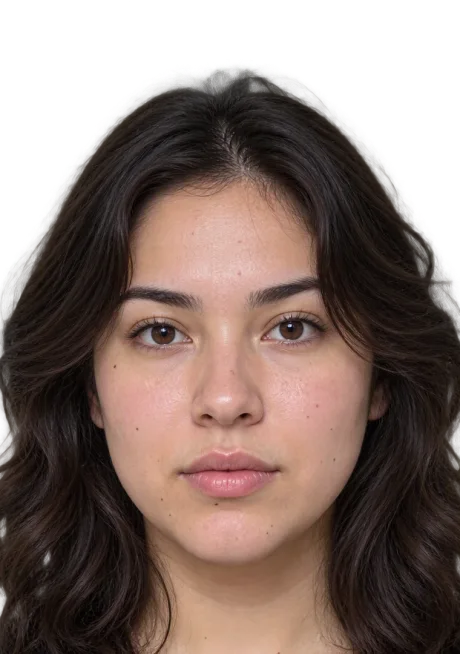
478-point landmark map
Step 1 of 2 · front photo
Add a front photo of your face
Face the camera straight on, camera at eye level, chin level, lips together, hair off the face. How far away the camera is gets worked out from the photo.
How it works
Add your photo
Camera or upload, either works.
Mapped in your browser
478 landmarks, entirely on your device.
Your measured result
Numbers and lines drawn on your photo.
On-device · never uploaded
Width, length and size
Free · no signup
The science
What is my nose type?
01
Most named nose types describe the nose from the side. A Roman nose has a bridge that bows out with a hump; a Greek nose has a straight bridge; an aquiline or hawk nose has an arched bridge and a tip that hooks down; a snub or button nose is short, with a scooped bridge and a tip that turns up; a celestial nose is a longer, gentler scoop into an upturned tip. From the front, noses are described by width and tip: narrow, wide (the Nubian nose is a wide base with a long columella) or bulbous, a full, rounded tip.
02
None of these is a medical category, and most noses mix them. What a photo can measure is the shape behind the names. From the front: how wide and how long your nose is for the gap between your eyes, and how big that makes it. From the side: whether your bridge bows out, runs straight or scoops in. This nose shape detector measures both, compares each reading with 165 faces measured the same way, and names the type the numbers point to.
Is my nose big? How the test measures it
The test finds 478 points on your face and takes two measurements of your nose: its width, between the outer edges of your nostril wings, and its length, from the bridge between your eyes to the base of your nose. Both are measured in units of the gap between your inner eye corners, the face’s own ruler in the rule of fifths, and the size is the width times the length. The points are read on the face model’s 3D mesh, on your photo and on its mirror image, averaged, because the model does not place a face and its mirror image the same (the photo alone and its mirror alone put the size 7 points apart at the median).
Each reading is compared with 165 front-facing photos of public figures, 84 men and 81 women, measured exactly the same way: press, event and sports photos taken by photographers, with the head straight and the lips together, because an open smile pulls the nostril wings about 6.5% wider. A reading becomes "wider than 64% of women’s noses" instead of a raw ratio. Men and women are compared separately because men’s noses read wider for their eye gap; Everyone compares you with all 165. Measuring against the eye gap has one catch: wide-set eyes make a nose read smaller, close-set eyes larger.
Nose size chart: what each band means
The size bands split the reference faces of each sex into about 15% at each end, 20% next to them and 30% in the middle, so an average result is the most common one.
| Share of noses yours is bigger than | Band | Share of faces | What it means |
|---|---|---|---|
| 85 and up | Big nose | About 15% | Bigger than about 6 noses in 7 for the gap between the eyes. |
| 65 to 84 | Larger than average | About 20% | Above the middle of noses, usually from width or length, rarely both. |
| 35 to 64 | Average size | About 30% | The middle of noses for the gap between the eyes. |
| 15 to 34 | Smaller than average | About 20% | Below the middle, usually from a narrower or shorter nose. |
| Under 15 | Small nose | About 15% | Smaller than about 6 noses in 7 for the gap between the eyes. |
For width and length, the middle half of men reads 1.22 to 1.33 and 1.39 to 1.55 eye gaps; the middle half of women reads 1.13 to 1.24 and 1.36 to 1.49. Above the middle half reads wide or long, below it narrow or short.
Do selfies make your nose look bigger? How the test corrects for the camera
A camera close to your face enlarges whatever is nearest to it, and the nose is the nearest part. Ward and colleagues (JAMA Facial Plastic Surgery, 2018) worked out that a photo from about 30 cm makes the base of the nose look about 30% wider than one from 1.5 m. The reference faces were photographed from a distance, so a selfie compared with them would read big for the wrong reason.
The test handles it in two ways. It measures the nose against the gap between your eyes, which sits only a little behind the nose, instead of the width of your face, which sits far behind it: simulated on the reference faces’ own 3D landmarks, a photo from 50 cm read the size 46 points high against the width and height of the face, and 11 points high against the eye gap. Then it works out how far away the camera was and moves every point back by its own depth, read from the face model. The distance comes from your iris, which is close to 11.7 mm across in adults (11.71 mm on average, give or take 0.42 mm, in 390 adults: Rüfer and colleagues, Cornea, 2005): how many pixels it spans says how far away the camera was, once the camera’s focal length is known.
The focal length comes from one of three places. A photo from this page’s camera uses a typical front camera: the middle of four with published fields of view (a Logitech C920 webcam, a Galaxy S24, an iPhone 13 and a Pixel 8), which reads the distance from 8% too near to 20% too far depending on the camera. An uploaded photo uses the focal length its camera wrote into the file, when the file still has it and has not been cropped. Without either, the test assumes an arm’s length selfie, 45 cm, the arm’s length of Pressler and colleagues (Plastic and Reconstructive Surgery, 2022), and the result says it assumed one.
In the same simulation, with the iris varied by that spread: a selfie from this page’s camera reads the size within 3.1 points of a far-away photo in 9 of 10 (0.7 at the median), an uploaded photo that keeps its focal length within 0.9, and the arm’s length assumption within 7.9 for selfies, but about 8 points small at the median for a photo taken from 1 or 2 m. On real photos, Pressler and colleagues measured noses 6.4% longer at 30 cm and 4.3% longer at 45 cm than at 1.5 m; the same geometry reads 4.9% and 2.8%, the same direction and a little less, so a close photo may still read a little long. For the truest reading, have someone take the photo from 1 m or more, or prop your phone and use the timer.
Nose types chart: Roman, Greek, aquiline, button and Nubian noses
The named types split into two families. Profile types (Greek, Roman, aquiline, snub or button, celestial) are about the bridge and the tip seen from the side; front types (narrow, wide or Nubian, bulbous) are about width and the tip seen from the front. The chart draws each one with the straight line the side reading measures against, and says what this test reads for it.
A front photo cannot see a bridge, so a profile type needs a side photo. Without one, the result names your front shape (for example "Narrow and long") and your size, and leaves the bridge out instead of guessing it.
From the side: the bridge
Straight (Greek)
One straight line from between the eyes to the tip.
Reads Straight: hump under 5.0%, scoop under 1.0%
Roman
A convex bridge with a hump, the tip level.
Reads Roman: hump of 5.0% or more of the bridge line
Aquiline (hawk)
An arched, convex bridge and a tip that hooks down.
Reads Roman: the bridge is measured, the hooked tip is not
Snub (button)
A short nose with a scooped bridge and a tip that turns up.
Reads Snub: scoop of 1.0% or more; the turned-up tip is not measured
Celestial (ski slope)
A long, gentle scoop that curves up into the tip.
Reads Snub when the scoop reaches 1.0%, else Straight
From the front: the width
Narrow
Nostril wings close together, narrower than most for the eye gap.
Reads Narrow: width in the lowest quarter of your group
Medium
The middle half of noses for the gap between the eyes.
Reads Medium width: the middle half of your group
Wide (Nubian)
A wide base with flared wings; the Nubian nose adds a long columella.
Reads Wide: width in the top quarter of your group
Bulbous (fleshy)
A wide, rounded tip that stands out from the wings.
Not graded: the test leaves the tip out
Roman nose vs Greek nose: how the side photo reads your bridge
On a side photo, the test traces the outline of your face with the same on-device model as the side profile analysis, finds the deepest point between your eyes and your nose tip, and draws a straight line between them. It then measures how far your bridge stands in front of that line, or sits behind it, between 20% and 50% of the way down, where the bridge is and the tip has not started. A bow of 5.0% of the line’s length or more reads Roman, a scoop of 1.0% or more reads Snub, anything between reads Straight (Greek).
There is no published set of side photos labeled by nose type to check this against, so the cut-offs were set on 24 generated side photos, one prompt per type, each labeled by eye before any reading was taken. The outline was traced on 22 of them; of the 19 with a sure label, 17 read as labeled, and the two that did not were snub noses with a slight scoop that read Straight. Across 8 versions of each labeled photo (rotated, cropped, half size, compressed), 141 of 152 were traced and 124 read as labeled. Generated studio photos are cleaner than most real ones, so take the side photo against a plain wall.
The tip is not read. The turn of the tip is what separates an aquiline nose from a Roman one and a snub nose from a celestial one, and on the test photos it did not tell them apart, so the result names the bridge and says the tip is not measured.
Nose width and the rule of fifths
The rule of fifths, an art and surgery canon, divides the face across into five eye widths and puts the nose in the middle one: as wide as the gap between the inner corners of the eyes. Measured on photos, every one of the 165 reference faces read wider than its eye gap, the narrowest at 1.04 times, because the points sit on the groove at the outer edge of each nostril wing and at the visible inner corner of each eye, not where a caliper would go. So the test never grades you against the rule’s 1.0; it compares your ratio with faces read the same way.
The nose also sets the middle of the facial thirds. The facial thirds test measures how your middle third compares with the other two, the philtrum ratio splits the third below your nose, and the golden ratio face calculator checks the classical ratios, including mouth width over nose width, which the nose to lip ratio guide explains.
Nose shape detector: how to take the photos
You need one front photo; the side photo is optional and adds the bridge. Both are read in your browser and never uploaded.
- Step 1Front photo: camera at eye level, face straight on, chin level, lips together and relaxed, hair off your face. From 1 m or more reads truest: ask someone, or prop the phone and use the timer. The test turns away a head turned more than about 15°, tilted or tipped more than 15°, or a smile with the lips apart, and says which.
- Step 2Choose who to compare with: women’s noses, men’s noses or everyone. How far away the camera was is worked out from the photo.
- Step 3Side photo, if you want the bridge: turn 90° so only one eye shows, against a plain wall, hair off your forehead, glasses off, chin and neck in frame. A second person holding the phone at nose height works best.
- Step 4Read your size band, your width and length against your group, your front shape and, with a side photo, your bridge.
A tipped head changes how long a nose reads, by about 3.3% per 10° on the reference faces; the test reads the tip from your face and takes it out. Take two photos the same way; if they land in different bands, the photo is the variable, not your nose.
Can you change your nose shape?
The shape is set by bone and cartilage, which exercises and nose-shaping clips do not change in adults. What you can change is how it reads. Contour makeup down the sides of the bridge is used to make it read narrower, and a highlight that stops short of the tip to make it read shorter; stylists balance a prominent nose with volume at the sides of the hair, a fuller beard or glasses with a heavier bridge. And a photo from further away shows it closer to its real size.
Filler injected by a qualified practitioner can smooth a scooped bridge or disguise a small hump, which is why it is sold as a non-surgical nose job, but it adds volume and cannot make a nose smaller. Making a nose smaller, narrower or straighter is rhinoplasty, and whether it suits your face is a decision for a board-certified facial plastic surgeon after an examination, not for a percentile.
FAQ
Common questions
Is my nose big?+
Upload a front photo and the test answers with a share of noses: your nose width times its length, both measured in units of the gap between your inner eye corners, against 165 measured faces, compared within your own sex. 85 and up reads Big nose, 65 to 84 Larger than average, 35 to 64 Average size, 15 to 34 Smaller than average and under 15 Small nose, which splits the reference faces about 15, 20, 30, 20 and 15%. Because a close camera makes a nose look bigger, the test works out how far away the camera was from your iris and corrects for it.
What nose shape do I have?+
From the front, the test names your width and length against noses of your own sex: wide or narrow when your width falls in the top or bottom quarter, long or short for length, medium in between, so a result reads like "Wide, medium length". Add a side photo and it names your bridge too: Roman when the bridge bows out by 5.0% of its length or more, Snub when it scoops in by 1.0% or more, and Straight (Greek) in between.
How do I know if I have a Roman nose?+
From the side, a Roman nose has a bridge that bows forward between the eyes and the tip, the hump you can feel along it. The test measures it on a side photo: it traces your profile, draws a straight line from the deepest point between your eyes to your nose tip, and reads Roman when the bridge stands out from that line by 5.0% of the line’s length or more. An aquiline or hawk nose reads Roman too: the test measures the bridge, not the hook of the tip.
What is a Greek nose?+
A Greek nose has a straight bridge that runs in one line from between the eyes to the tip, the profile of classical Greek statues. On a side photo the test reads Straight (Greek) when the bridge bows out by less than 5.0% of its length and scoops in by less than 1.0%.
What is a button nose?+
A button nose is small and short, with a scooped bridge and a rounded tip that turns up. The test reads its two measurable parts: from the front, a length in the bottom quarter of your group reads Short; from the side, a scoop of 1.0% of the bridge length or more reads Snub, the family button and celestial noses belong to. The turn of the tip itself is not measured.
What are the different nose types?+
From the side: Greek (straight bridge), Roman (a bridge that bows out with a hump), aquiline or hawk (an arched bridge with a tip that hooks down), snub or button (short, scooped, tip up) and celestial (a long, gentle scoop into an upturned tip). From the front: narrow, wide or Nubian (a wide base with a long columella) and bulbous or fleshy (a full, round tip). Most noses mix two or more.
Do men have bigger noses than women?+
Among the reference faces, yes, for the gap between the eyes. Men’s noses are wider (a median of 1.27 times the gap against 1.20 for women) and about as long (1.45 against 1.43), so their size reads about 9% larger. That is why the test compares you with your own sex.
Do selfies make your nose look bigger?+
Yes. A photo taken from about 30 cm, a typical selfie, makes the base of the nose look about 30% wider than the same face photographed from 1.5 m, because the nose is closer to the lens than the rest of the face (Ward and colleagues, JAMA Facial Plastic Surgery, 2018). The test works out how far away the camera was from the size of your iris and corrects for it with your face’s own depth, and it measures against the gap between your eyes, which sits close to the nose’s depth, rather than the width of your face. A photo from 1 m or more still reads truest.
How accurate is the nose shape detector?+
The same photo always gives the same result. To see how much a second photo could move it, every reference photo was measured in 8 versions (rotated, cropped, half size, compressed): the size moved 4 points at the median and about 12 or less in 9 pairs of 10, and the size band stayed the same in 76% of pairs. The camera’s distance, worked out from your iris, adds little with this page’s camera (the size within 3.1 points in 9 selfies of 10, simulated) and more when a photo carries no camera data and an arm’s length selfie is assumed. The side reading was set on 24 generated side photos labeled by eye, not on real ones, and read the bridge as labeled on 17 of the 19 with a sure label.
Can you change your nose shape without surgery?+
Not the bone and cartilage that set it. Contour makeup can make a nose read narrower or straighter in photos, and dermal filler placed by a qualified injector can smooth a dip or disguise a small hump, but filler adds volume, so it cannot make a nose smaller. Changing the size or the shape of the bridge is rhinoplasty, a decision for a board-certified facial plastic surgeon, never for a test score.
Is my photo uploaded?+
No. The face model and the profile tracing run in your browser, and both photos stay on your device. Nothing about your face is sent to a server.
Keep going
Side profile analysis →
Facial convexity and the E-line, measured from your profile photo.
Facial thirds & ratios →
Upper, middle, and lower thirds — where yours differ.
Philtrum & chin ratio →
How your lower third splits between philtrum and chin.
Golden ratio calculator →
Your facial proportions against the classical ratios.