
Free · runs on your device
Lip shape detector
Fullness, upper-to-lower balance, and width measured from your lip landmarks — plus what flatters your measured shape.
CostFree
TimeUnder 1 min
SignupNone
DataStays on device
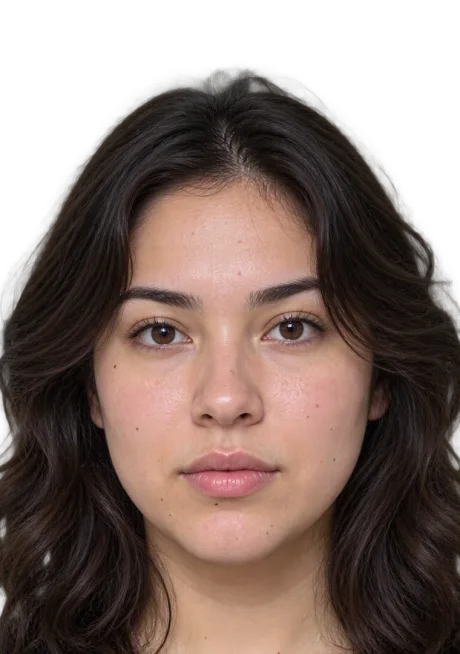
478-point landmark map
Step 1 of 2 · your photo
Add a photo to measure
Face the camera straight on, hair off the face, even light, no tilt.
How it works
Add your photo
Camera or upload — either works.
Mapped in your browser
478 landmarks, entirely on your device.
Your measured result
Numbers and lines drawn on your photo.
On-device · never uploaded
478 landmarks
Free · no signup
The science
How lip shape is measured
01
This tool measures three things from your lip landmarks: overall fullness (lip height relative to mouth width), the balance between upper and lower lip, and mouth width relative to your face. Those three numbers separate the common shape labels — full, wide, bow-shaped (defined cupid’s bow with a fuller center), and thinner or evenly balanced lips.
02
The typical lower lip is noticeably fuller than the upper — ratios around 1 : 1.6 are the population norm, which surprises people who assume balanced lips are standard. A strong cupid’s bow is an independent trait: you can have thin lips with a sharp bow or full lips with a soft one.
03
Practically, shape drives technique: overlining works best confined to the center of the upper lip on bow shapes, gloss placement differs on wide versus full lips, and dark liner visually narrows a wide mouth. Knowing the measured shape turns those from generic tips into ones aimed at your actual geometry.
The overlining playbook, by measured shape
Thin-balanced lips: overline the center third of both lips by a millimeter, never the corners — corner overlining is what reads as visible makeup. Full lips: skip overlining; a liner exactly on the border with gloss center-stage maximizes what is there. Bow-heavy shapes: resist sharpening the bow further; softening it with liner reads fuller. Wide-thin lips: bring the visual focus inward — deeper color at the center fading outward (the Korean gradient technique) narrows and plumps simultaneously. Uneven upper-lower balance: overline only the smaller lip’s center, which this tool’s ratio identifies precisely. Every trick is placement; the measured shape tells you the placement.
FAQ
Common questions
What is the most common lip shape?+
A lower lip about 1.6× the height of the upper, moderate width, and a soft cupid’s bow. Perfectly balanced upper and lower lips are the exception, not the rule.
How can I make my lips look fuller without filler?+
Overline only the center third of the lips, keep the corners at your natural line, add gloss or a lighter shade in the center, and use liner one shade darker than your lipstick at the edges. Center-weighted tricks read natural; full-perimeter overlining does not.
Is my photo analyzed privately?+
Yes — the landmark model runs in your browser and the photo never leaves your device.
Do lips get thinner with age?+
Yes — collagen loss and the philtrum lengthening thin the visible upper lip especially, usually from the late 30s. Center-weighted overlining and hydrating glosses counteract the read; retinoids on the lip border have modest evidence for the structure.
What lip shape do fillers give you?+
Whatever is injected — which is the problem with trend-driven work. Good injectors enhance your measured ratio (fuller center on a bow shape, balanced volume on thin-balanced) rather than installing one template; bring your measurements to the consult.