
Free · runs on your device
Philtrum and chin ratio
How your lower third splits between philtrum and chin, measured from one front-facing photo and compared with the proportion artists conventionally cite.
CostFree
TimeUnder 1 min
SignupNone
DataStays on device
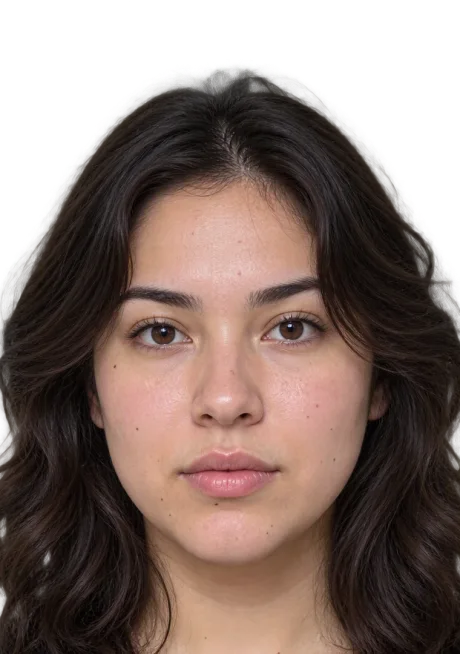
478-point landmark map
Step 1 of 2 · your photo
Add a photo to measure
Face the camera straight on, hair off the face, even light, no tilt.
How it works
Add your photo
Camera or upload, either works.
Mapped in your browser
478 landmarks, entirely on your device.
Your measured result
Numbers and lines drawn on your photo.
On-device · never uploaded
478 landmarks
Free · no signup
The science
What your philtrum-to-chin ratio means
01
This tool measures the philtrum, the groove from the base of the nose to the top of the upper lip, against the distance from the bottom of the lower lip to the bottom of the chin. The artistic canon splits the lower face one part to two, but it measures to where the lips meet, so the lips count in; this ratio leaves the red of both lips out, which lowers it. On 158 faces of public figures, read as a phone at arm’s length sees them, the middle 80% read 0.33 to 0.64 for men and 0.34 to 0.54 for women, so 0.33 to 0.65 reads typical here. Above 0.65 the philtrum reads long, which is the feature people notice as a long upper lip.
02
A long philtrum is common, it lengthens further with age as the upper lip loses volume, and it is one of the few measurements here with a real, well-established cosmetic procedure attached: a lip lift, which shortens it by removing a strip of skin under the nose. That is surgery, with a scar under the nose that is usually well hidden but is permanent.
03
Below the range the philtrum reads short and the chin long, which usually means the chin is the feature to look at rather than the lip. Nothing non-surgical changes philtrum length. What you can change is the balance of the lower third with beard shape, lip color and how the chin is framed, which is what the face-shape and lip tools on this site are for.
FAQ
Common questions
What is an ideal philtrum length?+
No medical ideal exists. The artistic convention is roughly one part upper lip to two parts lower lip and chin, measured with the lips in. This tool leaves the lips out, and most faces read 0.33 to 0.65 on it; above 0.65 the upper lip reads long.
Can you shorten your philtrum naturally?+
No. It is bone and soft tissue and does not respond to exercises or massage. A lip lift is the only procedure that meaningfully shortens it, and it is a permanent surgical change.
Does philtrum length change with age?+
Yes, it lengthens slowly over decades as the upper lip loses volume. A ratio that reads balanced at 25 can read long at 55.
Does this need a side photo?+
No. Front-facing, head level, mouth relaxed. Smiling shortens the philtrum and makes the reading wrong.
Keep going
Nose shape detector →
What nose shape do you have, and is it big? Width, length and size measured against 165 faces, plus the bridge from a side photo.
Pore-clogging ingredient checker →
Paste a product, or browse the full list with comedogenic ratings.
PSL score test →
Your measured facial geometry placed on the 1 to 8 PSL scale, with the full tier chart.