
Free · runs on your device
Pupillary distance tool
Your PD in real millimeters from one photo — scaled by your iris, which is a near-constant 11.7mm in adults. Precise enough for ordering standard glasses online.
CostFree
TimeUnder 1 min
SignupNone
DataStays on device
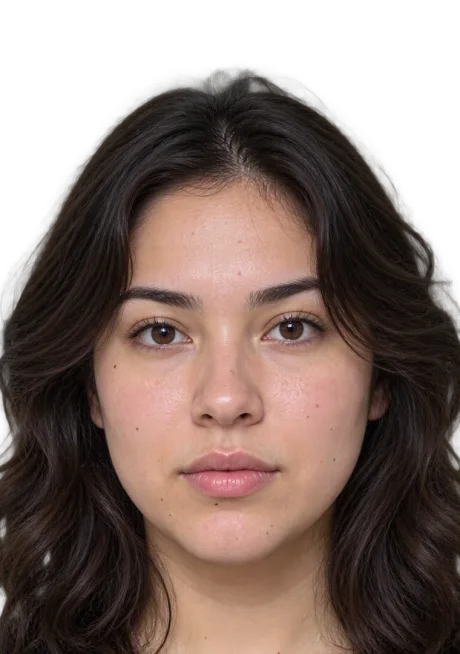
478-point landmark map
Step 1 of 2 · your photo
Add a photo to measure
Face the camera straight on, hair off the face, even light, no tilt.
How it works
Add your photo
Camera or upload — either works.
Mapped in your browser
478 landmarks, entirely on your device.
Your measured result
Numbers and lines drawn on your photo.
On-device · never uploaded
478 landmarks
Free · no signup
The science
How a photo can measure millimeters: the iris trick
01
A photo has no absolute scale — unless something in it has a known real-world size. The human iris is that something: adult horizontal iris diameter is remarkably constant at about 11.7mm (±0.5) across ages, sexes, and ethnicities. This tool detects both irises with the landmark model, uses their pixel diameter to establish scale, and then measures the distance between your iris centers — your PD — in real millimeters. It is the same principle as the credit-card methods, with a reference you cannot forget to include.
02
Accuracy runs about ±1–2mm versus a clinical pupillometer, which is fine for ordering standard single-vision glasses (frames tolerate small PD error). For strong prescriptions, prism corrections, or progressives — where lens alignment matters to the millimeter — get measured in person. Distance PD is what this measures; near PD (for reading glasses) runs about 3mm less, which the tool also reports.
Using your PD to order glasses online
Every online glasses checkout asks for PD, because it positions the optical center of each lens in front of your pupil. Enter the distance PD from this tool for regular and computer glasses; if the retailer asks for near PD (reading glasses), use the near value — it is smaller because your eyes converge to read. Some checkouts ask for "dual PD" (per-eye, measured from the nose bridge): if yours differs, halving the total is usually within tolerance for standard prescriptions, but a pupillometer measurement is better when the site insists.
Tolerance context: optical standards allow a couple of millimeters of decentration for typical prescriptions before induced prism becomes noticeable, which is why a ±1–2mm photo measurement works for most orders. The exceptions are strong prescriptions (roughly ±4.00 and beyond), prism corrections, and progressives — those magnify placement errors, so get measured in person for them.
Why the iris trick works
Photogrammetry needs a real-world reference, and the adult human iris is one of the most size-stable structures in the body: horizontal visible iris diameter averages ~11.7mm with a standard deviation near half a millimeter, across sexes and ethnicities, and it stops growing in childhood. Detect both irises precisely — the landmark model traces each with five points — and the pixel-to-millimeter scale falls out. It is the same principle as the credit-card-on-forehead methods, minus the credit card, and with a reference that cannot be held at the wrong depth.
FAQ
Common questions
What is a normal PD?+
Most adults measure between 54 and 74mm, with ~63mm the adult average. Yours is fixed after your face finishes growing — it does not change with age.
Is a photo PD accurate enough to order glasses?+
For standard single-vision prescriptions, yes — ±1–2mm is within what frames tolerate. For high prescriptions, prisms, or progressives, get a clinical measurement; alignment errors are magnified by strong lenses.
Why does the tool say my measurement is out of range?+
The iris-scale math produced an implausible value — usually the camera was too close (lens distortion), the face turned, or glasses distorted the eye region. Arm’s length, straight on, glasses off fixes it.
Is PD the same for both eyes?+
Rarely exactly — faces are asymmetric, so per-eye ("dual") PD often differs by a millimeter or so. Standard single-vision orders tolerate this; progressive lenses are where per-eye precision starts mattering.
Does PD change with age?+
Not after facial growth completes in the late teens. A PD measured at 25 is a PD for life, which is why it is worth measuring once properly and keeping.
Can I use my PD from an old prescription?+
If it is on the prescription, yes — optometrist-measured PD is the gold standard. Many prescriptions omit it (it is technically a dispensing measurement), which is exactly why this tool exists.