
Free · runs on your device
How old do I look?
How old your face reads, estimated by a neural model running entirely in your browser — then compared to your actual age. No upload, ever.
CostFree
TimeUnder 1 min
SignupNone
DataStays on device
On-device age model
Step 1 of 2 · your photo
Add a photo to estimate
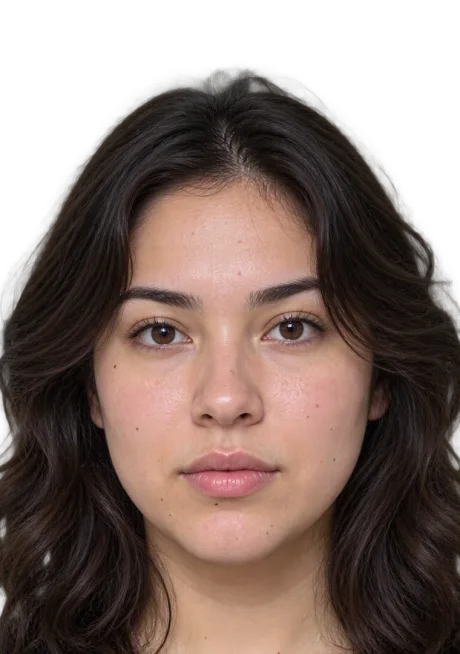
Face the camera straight on, even light, no filter — filters are built to change exactly what this measures.
How it works
Add your photo
Camera or upload — either works.
Mapped in your browser
478 landmarks, entirely on your device.
Your measured result
Numbers and lines drawn on your photo.
On-device · never uploaded
Neural age estimate
Free · no signup
The science
How face age estimation works — and what moves the number
01
This tool runs a small neural network in your browser (about 630KB of model weights, loaded from our own server, with your photo never leaving your device). The model was trained on hundreds of thousands of labeled faces to map visual features — skin texture, volume distribution, fine lines, contrast — to an age estimate. Accuracy is roughly ±5 years, and lighting, angle, and expression each move it: the same face can read 3–4 years apart between a harsh overhead photo and soft daylight.
02
What genuinely moves perceived age is well studied, and the ranking surprises people: UV damage dominates — photoaging drives most visible skin aging, which makes daily SPF the single biggest lever. After that: retinoids (the best-evidenced topical), skin evenness (uniform tone reads years younger than the same skin with spots), sleep, and smoking. Genetics sets the baseline; those levers set the trajectory. One estimate is a snapshot — the same photo conditions repeated monthly is where the signal lives, which is what the SkinPal app is built around.
What makes a face read older than it is
Perceived age research is specific about the drivers, and they are not what most people guess. Uneven pigmentation — sun spots, melasma, post-acne marks — ages a face in ratings more than wrinkles of the same visual weight; studies that digitally even out tone drop perceived age by years without touching a single line. After tone: skin texture and pore visibility, volume distribution (the midface flattening that starts in the 30s), dynamic lines becoming static ones, and hair choices framing it all.
That ranking is good news, because the biggest driver is the most treatable. Photoaging from UV accounts for the large majority of visible skin aging on exposed skin, which is why the boring answer — daily broad-spectrum sunscreen — outperforms every serum on this specific outcome. Retinoids are the second-best-evidenced lever; they take months and work on both texture and tone.
Getting a reliable reading (and tracking it)
The estimate is only as stable as the photo: soft frontal daylight, neutral expression, no filter, camera at eye level and at arm’s length or more. Overhead bathroom light adds shadows that read as years; a big smile adds folds the model reads as lines. Shoot the same setup twice and the estimates typically agree within a year or two — that repeatability is what makes the number usable.
The one-photo number is a snapshot; the interesting question is direction. If you start a retinoid or finally get consistent with SPF, re-estimate monthly under the same conditions. Changes of one to three "years" over a few months are exactly the magnitude the levers above produce — and exactly what a single glance in the mirror cannot detect. The SkinPal app automates this: controlled capture, eight scored metrics, and week-over-week tracking.
FAQ
Common questions
How old do I look to other people?+
Roughly what this estimates: a neural model trained on hundreds of thousands of labeled faces produces the same kind of calibrated guess a stranger makes. Under good lighting it is typically within ±5 years of how people rate the same photo.
How accurate is a face age test?+
Neural estimates are typically within ±5 years under good conditions. Filters, makeup, harsh lighting, and angles push it further. Treat it as a calibrated impression — the same thing strangers do, minus the politeness.
Is my photo uploaded to a server?+
No. The model weights download to your browser and the estimate is computed on your device. You can verify in your browser’s network tab — the photo never transmits.
How can I make my face look younger?+
In evidence order: daily broad-spectrum SPF (the biggest lever by far), a retinoid at night, treating uneven tone, sleep, and not smoking. Everything else on the market is fighting over the remaining few percent.
Why does the test say I look older than people tell me?+
People you know rate you with context — expression, voice, familiarity — and politeness. The model rates one frozen frame. Both are real answers to different questions; the model’s is closer to how a stranger reads a photo of you.
Do filters change the estimated age?+
Dramatically — smoothing filters are engineered to remove exactly the texture and tone signals the model reads. An estimate from a filtered photo is an estimate of the filter.
Can my face age estimate go down?+
The perceived-age drivers respond to treatment: evening out tone (SPF + vitamin C or azelaic acid) and improving texture (retinoids) reliably shift how both people and models read a face — typically by a small number of years over months, not weeks.
Keep going
Skin type test →
Eight questions to place you as dry, oily, combination, normal, or sensitive-leaning.
Acne severity test →
Six questions that place your breakouts on a mild-to-severe scale and explain the bands.
Dehydrated skin test →
Tell dehydration apart from dry skin — one is a lack of water, the other a lack of oil.