
Free finder · no signup
Hair parting finder
Middle, side, or deep side — what your face shape says, and why the cheapest experiment in beauty (ten seconds, fully reversible) is worth doing deliberately.
CostFree
TimeUnder 1 min
SignupNone
DataKept on device
Your face shape
Not sure? Measure it from a photo first →
Start your glow up
SkinPal on iPhone and Android
Next step · SkinPal app
Look good in every photo, not just this one.
The right haircut and glasses are a start. SkinPal builds your full glow up plan: styling, exercise, daily habits and skin care, and keeps you on it every day.



What you unlock in the app
- Full face analysisProportions, symmetry and skin, measured from one selfie
- Full skin report cardSee what's good and what needs work, from acne to skin age
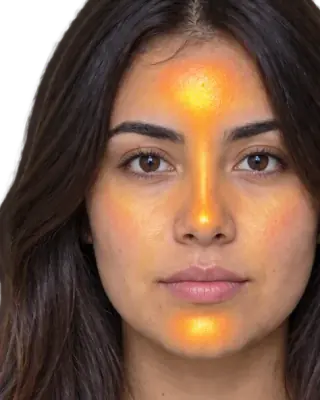
- Heatmaps of your faceSee exactly where redness, oil and breakouts are
- Flare, your AI skin coachAsk anything, get answers based on your own face
- Morning and night routineMade for you, and it changes as you improve
- Ingredient scannerKnow if a product suits you before you buy it
- Progress trackingSee your before and after, week by week
The science
What a parting actually changes
01
A parting does two things: it sets symmetry (middle parts frame the face in mirror-image curtains; side parts break symmetry with a diagonal), and it decides where volume falls. Symmetric framing flatters balanced and heart geometry; asymmetry flatters round and square faces by cutting across their regularity; and volume placement is the real lever for long faces, which need width at the sides more than any particular part line.
02
The middle-vs-side generational war misses that both are tools: the "rule" is only that your parting should serve your geometry. And partings are the cheapest experiment in this entire category — zero cost, ten seconds, fully reversible — so treat the recommendation as a starting hypothesis and check it in the mirror.
Changing your part without the awkward phase
Hair trains to a part through cuticle direction and root memory, which is why a fresh part flops back or stands up. The transition kit: switch on wash day, blow-dry the roots in the NEW direction while flipping the hair opposite-then-back (over-directing trains the root), set with a light hold product, and clip the front while it dries if needed. Two to three wash cycles and the new part self-maintains. Bonus effect worth knowing: periodically switching sides gives roots a lift on each switch and evens sun and heat wear — the one styling habit that is also hair care.
FAQ
Common questions
Is a middle part or side part better for a round face?+
Side — ideally deep. The asymmetric diagonal breaks up the symmetric curves of a round face and adds a lengthening line. Middle parts frame round faces in matching curves, emphasizing the roundness.
Why does my face look different when I switch parts?+
You changed the symmetry of the framing and moved where volume sits — the two strongest quick levers on apparent face shape. It is not imagination; it is geometry.
What parting suits a long face?+
Either part works if it feeds side volume; what hurts is crown height and flat sides. A middle part with waves beats a deep part with flat hair.
Why does my part look thin?+
A part that never moves flattens and exposes the same scalp line for years, and sun hits it too. Switching sides or zig-zagging the line instantly doubles apparent density along the part — before considering any treatment.
Does a middle part make you look younger or older?+
It is the least forgiving part: perfectly symmetric framing highlights whatever asymmetry and length the face has. On balanced oval-to-heart faces it reads modern; on long or round faces the side part is doing quiet corrective work the middle part refuses.
Keep going
Norwood scale test →
What Norwood am I? Your hairline traced from one photo: temple recession, forehead height and your stage.
AI skin analysis →
Redness, tone evenness, shine and depth from one selfie, scored in your browser.
FFMI calculator →
Your fat-free mass index from height, weight and body fat, on the charts for men and women, up to the natural limit of 25.