
Free · runs on your device
Golden ratio face calculator
Your facial proportions measured against the classical phi ratios — with honest context: the science behind “phi = beauty” is thin, but the measurements themselves are real and useful.
CostFree
TimeUnder 1 min
SignupNone
DataStays on device
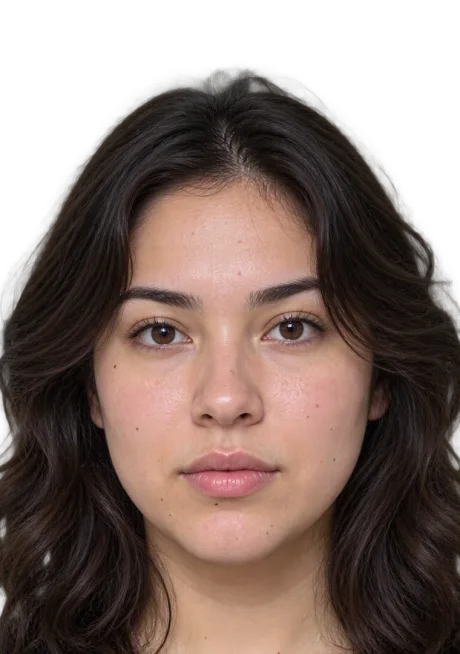
478-point landmark map
Step 1 of 2 · your photo
Add a photo to measure
Face the camera straight on, hair off the face, even light, no tilt.
How it works
Add your photo
Camera or upload — either works.
Mapped in your browser
478 landmarks, entirely on your device.
Your measured result
Numbers and lines drawn on your photo.
On-device · never uploaded
478 landmarks
Free · no signup
The science
The golden ratio and faces: measurement and myth
01
The golden ratio, phi (~1.618), appears in classical ideals of facial proportion: face length to width, lips-to-brow versus nose length, and mouth width versus nose width are the ratios most often cited. This tool measures those distances from 478 facial landmarks and reports how close each of your ratios sits to phi — measured geometry, not a mirror guess.
02
Now the honest part: the science behind “phi = beauty” is thin. Controlled studies find that attractive faces cluster around population-average proportions, not around phi specifically, and the famous phi-face claims mostly come from marketing rather than peer review. We built this tool because people search for it and deserve a measured answer with context — not because a 1.618 face is a goal.
03
What the measurement is genuinely useful for: understanding your own proportions. Knowing your face is longer than average, or your mouth-to-nose ratio is wide, is practical input for brows, hair, and glasses choices — the same measurements, pointed at decisions that actually change how you look.
Where the phi-face idea came from — and what survives scrutiny
The golden ratio genuinely appears in Renaissance proportion canons — Leonardo and Dürer drew idealized faces on phi-based grids — and twentieth-century cosmetic surgery revived it as the "Marquardt mask," a phi-derived template claimed to fit beautiful faces. Controlled research then tested it: attractive faces cluster around population-average proportions, the Marquardt mask fits fashion-model faces no better than averaged ordinary faces, and observers show no preference for phi-ratio composites over slightly different ratios. What survives is softer: ratios *near* the middle of the population range read as harmonious, and phi happens to sit near several of those middles.
So the honest use of this calculator is descriptive: your ratios, against both the phi reference and the typical bands, feeding the same styling logic as the other measurement tools. The number is trivia; the measurements underneath are the same ones the face shape and proportions tools put to work.
FAQ
Common questions
What is the golden ratio for a face?+
Phi, approximately 1.618 — classically applied to face length ÷ face width and several vertical proportions. This tool measures three of the most-cited ratios from your photo.
Is the golden ratio face scientifically proven?+
No. Studies of facial attractiveness find preferences for averageness, symmetry, and skin quality; specific phi ratios do not hold up as a beauty law. Treat the score as geometry trivia about your face, not a rating.
Does any celebrity actually have a golden ratio face?+
The viral “most beautiful face by science” lists use proprietary, unreviewed formulas. Measured carefully, every real face deviates from phi somewhere — including the faces on those lists.
Who has a perfect golden ratio face?+
Nobody measured carefully — every viral "science says this celebrity is perfect" list uses a proprietary unreviewed formula, and the same celebrities score differently on each. Real faces deviate from phi somewhere; famous ones included.
Is the golden ratio used in cosmetic surgery?+
Some surgeons use phi-derived guides as planning heuristics, alongside population norms and the patient’s own proportions. The evidence-based mainstream plans toward harmony with the individual face, not toward a universal mask.