Acne Face Mapping: What Your Breakout Zones Actually Mean
Acne face mapping explained, evidence-based: what your forehead, cheek, and chin breakout zones actually reflect (oil, friction, hormones — not organs), and how to track them over time.
Acne Face Mapping: What Your Breakout Zones Actually Mean
Acne face mapping is the idea that where a pimple shows up on your face means something. It is one of the most searched skincare topics — and one of the most misunderstood. This is an evidence-based guide to what a face map can and cannot tell you, and how to use breakout zones the useful way: as a tracking tool, not a diagnosis.
What is face mapping?
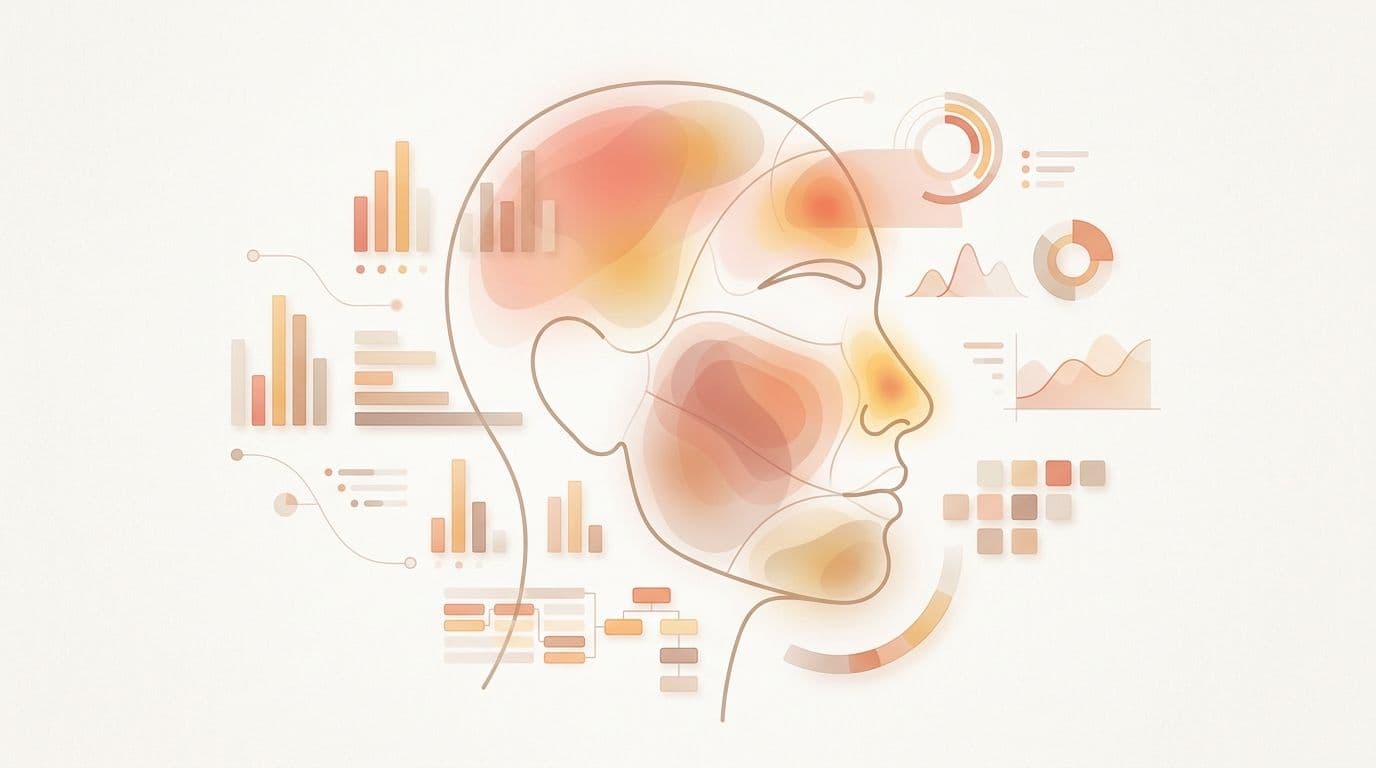
Face mapping divides the face into zones — forehead, nose, cheeks, chin and jaw — and looks at where breakouts, oiliness or other changes cluster. The concept comes in two very different flavours, and telling them apart matters.
Traditional face mapping (sometimes called Chinese face mapping) links each facial zone to an internal organ — the classic claim that a forehead pimple means a digestion problem, or a chin breakout means your liver. It is popular, but there is no good scientific evidence that a pimple's location reveals the health of a specific organ.
Modern, dermatology-informed face mapping is simpler and better supported: different zones of your face behave differently because of skin biology — how many oil glands are there, how much friction the area gets, and what touches it. That is the version worth using.
What your breakout zones can actually tell you
Location is a clue about skin factors, not organ health. Here is what the common acne zones tend to reflect, based on how skin actually works:
- Forehead and T-zone: this is the oiliest part of most faces, with the highest density of oil glands. Breakouts here often track with excess oil, hair products migrating down (sometimes called pomade acne), hats or fringes, and sweat.
- Nose: large pores and heavy oil flow make the nose prone to blackheads and congestion rather than deep cysts.
- Cheeks: frequently an external-contact zone — phone screens, pillowcases, hands, and mask friction. Cheek patterns are worth comparing against your daily habits.
- Chin and jawline: this zone is the one most associated with hormonal fluctuation in the research, which is why many people notice a monthly pattern here.
None of this is a diagnosis. Two people with a chin breakout can have completely different causes. What location gives you is a starting question — "what is different about this zone?" — not an answer.
The honest limits of a face map
A face map cannot diagnose a medical condition, identify an organ problem, or tell you what to take. Persistent, painful, cystic, or suddenly worsening acne is worth seeing a dermatologist about — location on a chart will not fix it, and some conditions that look like acne are not acne at all.
Used within those limits, though, zone patterns are genuinely useful — because they are trackable.
How to actually use acne face mapping
The value of a face map is not the single snapshot. It is the trend. If you note which zones break out and compare that against what changed — a new product, a stressful week, a hormonal phase, a dirtier pillowcase — you start to see your own patterns instead of guessing.
That is exactly what zone-by-zone tracking is for. Rather than eyeballing the mirror, a consistent photo record of each zone over time turns "I think my chin is worse this week" into something you can actually check.
SkinPal AI does this automatically: one selfie is analyzed across eight visible metrics zone by zone with an AI skin scanner, including acne, and saved so you can compare breakout zones week to week. It is a cosmetic tracking and education tool, not a medical device, and it does not diagnose skin conditions.
If you want the data behind where acne actually clusters, we also broke down what 11,000 anonymized face scans reveal about acne zones.
The takeaway
Acne face mapping works — as long as you use the evidence-based version. Your breakout zones reflect oil, friction, contact and hormones, not the state of your internal organs. Treat a face map as a way to notice patterns and track change over time, and it becomes a practical tool. Treat it as a diagnosis, and it will mislead you.
Want to see these changes on your own face instead of reading about them? SkinPal's free AI skin analysis reads eight skin metrics from a single selfie and tracks how they change over time. Learn more about the SkinPal AI app.
About the Author
SkinPal AI Editorial Team Content prepared by the SkinPal AI team for general skincare education. It is not medical advice and is not medically reviewed unless a named, verifiable reviewer is explicitly listed.