How to Track Acne Progress Over Time with AI
Learn how to use AI-powered skin tracking to monitor acne improvement over weeks and months. Includes tips on identifying triggers, measuring treatment effectiveness, and setting realistic goals.

Data-Driven Acne Tracking with SkinPal AI
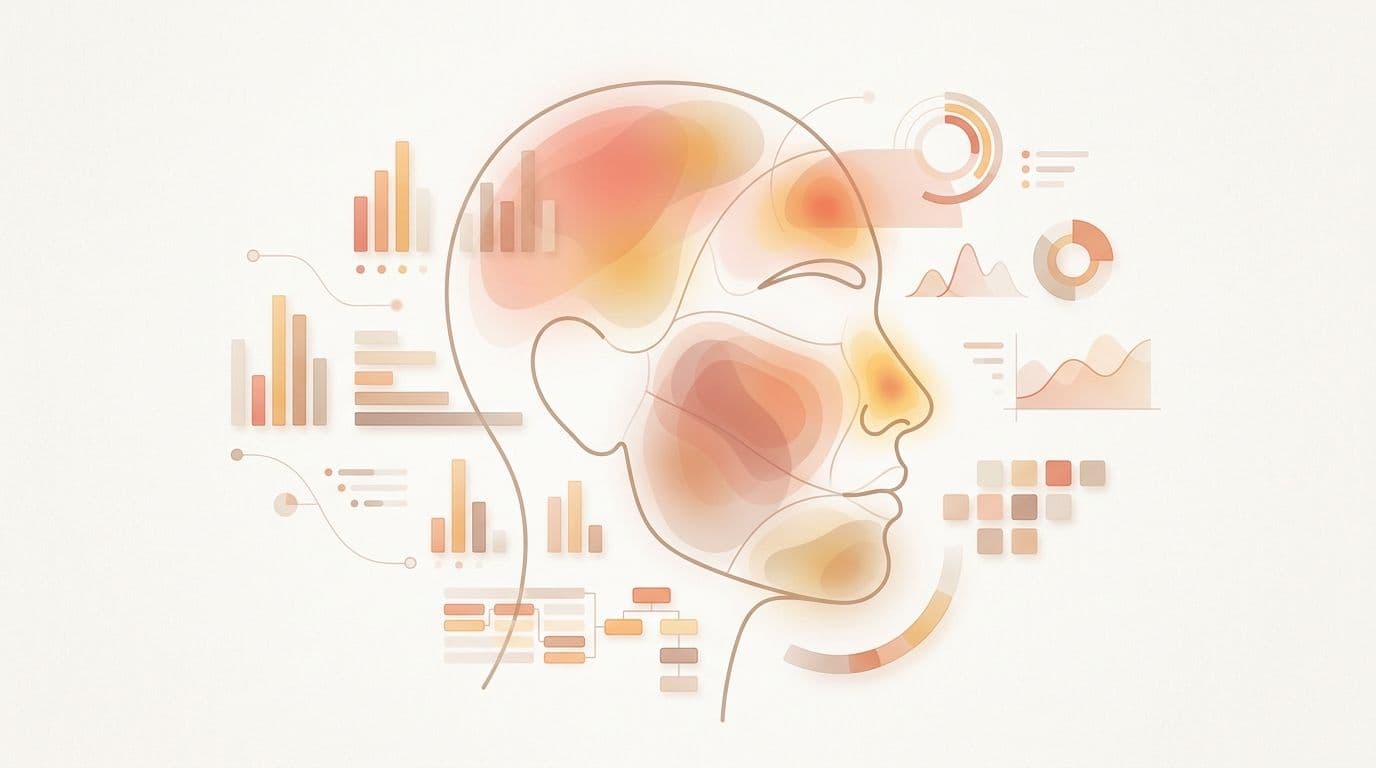
Tracking acne progress requires consistent daily photos analyzed by AI to measure breakout frequency, severity, and location over time. Rather than relying on memory or subjective impressions, a data-driven approach reveals exactly what's working in your treatment and what isn't. By scanning your skin regularly and letting AI quantify changes in lesion count, redness, and affected zones, you build an objective record that guides smarter skincare decisions and keeps you motivated through the slow weeks when improvement is hard to see.
Why Tracking Acne Matters
Most acne treatments take 4 to 12 weeks to show meaningful results. That's one to three months of applying products, adjusting routines, and waiting — often without any visible confirmation that things are getting better. This is where most people quit.
The problem isn't the treatment. It's the gap between starting and seeing results. Acne improvement is gradual. A 10% reduction in active breakouts over two weeks is real progress, but your eyes can't detect it. You look in the mirror, see the same spots, and assume nothing is changing.
Tracking closes that gap. When you have data showing your skin score improved from 62 to 68 over the past three weeks, you have a reason to keep going. When you can see that your forehead cleared up even though your chin is still breaking out, you understand the treatment is working — just not everywhere at the same pace.
Without tracking, people cycle through products every few weeks, never giving anything enough time to work. They waste money, irritate their skin with constant switching, and lose confidence in their ability to manage acne at all.
How AI Tracks Acne Differently Than Visual Assessment
When you look at your skin in the mirror, your brain does something unhelpful: it focuses on the worst spots. That one inflamed cyst on your jawline dominates your perception, even if the other 80% of your face has visibly improved. This is called negativity bias, and it makes self-assessment unreliable for tracking skin conditions.
AI analysis doesn't have this bias. It evaluates your entire face systematically and measures specific metrics:
- Active lesion count — the total number of visible breakouts, tracked over time to show whether frequency is increasing or decreasing.
- Severity grading — distinguishing between mild comedones, moderate papules, and severe cystic lesions, because not all breakouts are equal.
- Zone location mapping — pinpointing which facial areas are affected (forehead, cheeks, chin, jawline) to identify pattern-specific triggers.
- Healing rate — measuring how quickly existing breakouts resolve between scans.
- Recurrence patterns — detecting whether breakouts return to the same zones, which can signal hormonal or product-related causes.
A person might say "my skin looks the same." AI might say "active lesion count dropped from 14 to 9, severity shifted from moderate to mild, and your left cheek zone has been clear for 12 days." That level of detail changes how you evaluate your treatment.
Setting Up Your Acne Tracking Routine
Consistency matters more than perfection. The goal is to create a scanning habit that generates reliable, comparable data over time. Here's how to set it up:
Scan daily, ideally in the morning. After cleansing and before applying any products, take your scan. Morning scans on bare, clean skin give the most accurate baseline because your face hasn't been affected by the day's products, sweat, or environmental exposure.
Use consistent lighting. Natural daylight near a window works best. Avoid harsh overhead lighting or dim bathroom lights that create shadows. AI analysis is more accurate when lighting conditions stay similar between scans.
Keep your face neutral. Don't smile, squint, or tilt your head. A relaxed, straight-on position ensures the AI can accurately map zones and compare scans day to day.
Log what you're using. Track the products in your current routine — cleanser, actives, moisturizer, SPF. When your data shows a change (positive or negative), you'll want to correlate it with what you were applying during that period.
Note lifestyle factors. Sleep quality, diet changes, stress levels, menstrual cycle phase, and new supplements all influence acne. A quick daily note takes 10 seconds and can reveal powerful correlations when you look back at your data over weeks and months.
Understanding Your Acne Data
Real acne improvement rarely looks like a straight line going up. Here's what to actually expect:
The upward trend with dips. Your overall skin score might go from 58 to 64 to 61 to 67 to 63 to 70 over six weeks. That's genuine improvement — the trend is clearly upward — even though individual days dipped. This is normal. One bad night of sleep or a stressful week can cause a temporary breakout without erasing your overall progress.
Hormonal cycling. If you menstruate, you'll likely see a pattern: skin improves during the follicular phase, then breaks out around ovulation or in the luteal phase. AI tracking over two to three cycles makes this pattern obvious, which means you can adjust your routine proactively (adding a targeted treatment a few days before your typical breakout window).
Product purging vs. real breakouts. When you start a retinoid or chemical exfoliant, your skin often gets worse before it gets better. This "purging" typically lasts 4 to 6 weeks and shows up in specific zones where you already tend to break out. A real adverse reaction, by contrast, causes breakouts in new areas or shows no improvement after 6 to 8 weeks. AI tracking data makes it much easier to distinguish between the two because you can see exactly where breakouts are occurring and whether they match your existing pattern.
When to change your approach. If your data shows no improvement — or worsening — after 6 to 8 weeks of consistent use, it's time to reassess. Either the product isn't right for your skin, the concentration isn't strong enough, or there's an underlying factor (like diet or hormones) that topical treatment alone can't address.
Common Acne Triggers AI Can Help Identify
One of the most valuable aspects of long-term acne tracking is correlating your skin data with lifestyle variables. Over weeks and months, patterns emerge that you'd never catch otherwise:
Sleep deprivation. Multiple studies link poor sleep to increased skin inflammation. If your scan data consistently shows lower scores after nights with less than 6 hours of sleep, that's actionable information — not a vague suspicion, but a documented pattern.
Dietary triggers. High-glycemic foods and dairy are commonly associated with acne flares, but the relationship is highly individual. Some people break out from whey protein but tolerate cheese. Others react to sugar but not milk. Tracking lets you test specific changes and see whether your data actually shifts.
Product reactions. Introduced a new serum two weeks ago? If your zone-specific data shows new breakouts in areas that were previously clear, that's a strong signal. Without tracking, you might not connect the timing.
Stress events. Cortisol spikes from exams, work deadlines, or personal stress can trigger breakouts 3 to 5 days after the stressful event. That delay makes the cause-and-effect invisible unless you're logging both stress and scan data.
Hormonal cycles. Beyond menstrual cycles, other hormonal shifts — starting or stopping birth control, thyroid changes, PCOS flares — create acne patterns that only become visible with consistent longitudinal data.
When to See a Dermatologist for Acne
AI tracking is a powerful tool for managing mild to moderate acne and evaluating treatments. But some situations call for professional medical intervention:
- Severe cystic acne. Deep, painful cysts that don't respond to over-the-counter treatments may require prescription medication like isotretinoin, antibiotics, or hormonal therapy. Don't wait months hoping it will resolve on its own.
- Active scarring. If your breakouts are leaving indented or raised scars, see a dermatologist sooner rather than later. Early intervention can prevent permanent scarring.
- No improvement after 3 months of consistent tracking. If you've maintained a routine for 12+ weeks and your data shows no meaningful trend improvement, a dermatologist can evaluate whether you need prescription-strength treatments or testing for underlying conditions.
- Emotional impact. If acne is significantly affecting your mental health, self-confidence, or daily functioning, that alone is a valid reason to seek professional help. You don't need to hit a severity threshold to deserve treatment.
Your tracking data is actually valuable in a dermatologist visit. Showing a doctor your trend data, zone maps, and timeline gives them far more information than saying "my skin has been bad lately."
How SkinPal AI Tracks Acne
SkinPal AI is built specifically for the kind of consistent, data-driven skin tracking described in this article. Here's what makes it useful for acne management:
Acne-specific metric tracking. Each scan analyzes your skin for active breakouts as part of your overall skin health score. You get a quantified measurement, not a vague assessment, so you can track real changes over days, weeks, and months.
Zone mapping. SkinPal maps your face into distinct zones and tracks which areas are affected. This shows you which zones clear first, which are persistently problematic, and whether breakouts are migrating — all useful signals for understanding your acne pattern.
Before and after comparison. Side-by-side photo comparisons with your scan history let you see visual change alongside the data. Sometimes the numbers tell you you're improving before you can see it yourself. Other times, comparing photos from week 1 and week 8 shows dramatic change you'd forgotten about.
Trend charts. Your skin score over time is plotted as a trend line, showing the trajectory of your treatment. Occasional dips don't obscure the overall direction. You can see whether your current approach is working at a glance.
Personalized routines. Based on your scan results, SkinPal generates a customized skincare routine targeting your specific concerns, so your tracking data directly informs your treatment approach.
Frequently Asked Questions
How long should I track my acne before expecting results?
Give any new treatment at least 6 to 8 weeks of consistent daily tracking before evaluating results. Some treatments, particularly retinoids, can take 12 weeks to show significant improvement. The data from daily scans will show whether subtle progress is happening even when your mirror doesn't reflect it yet.
How can I tell if my skin is purging or actually breaking out from a product?
Purging typically occurs in areas where you already break out, involves smaller lesions that heal faster than usual, and resolves within 4 to 6 weeks of starting a new active ingredient (like retinol, AHA, or BHA). If you're breaking out in entirely new areas, developing deeper or more inflamed lesions, or seeing no improvement after 6 weeks, it's likely a reaction to the product — not purging. AI tracking makes this distinction clearer because you can compare breakout locations and severity against your historical baseline.
Can AI track acne scars as well as active breakouts?
AI skin analysis primarily focuses on active skin conditions and overall skin health metrics. While scars can affect your overall skin texture and tone scores, dedicated scar tracking (measuring depth, color, and type of scarring) is better evaluated by a dermatologist. Use AI tracking to monitor active acne and prevent new scarring by catching breakouts early and evaluating treatment effectiveness.
Should teenagers use AI tracking for acne?
AI skin tracking can be helpful for teens managing acne, especially because adolescent acne changes rapidly and is strongly influenced by hormonal shifts during puberty. Having objective data can reduce anxiety about whether skin is improving and help teens (and their parents) make informed decisions about when to escalate to a dermatologist. That said, it works best as a complement to guidance from a healthcare provider, not a replacement — particularly for moderate to severe teen acne.
💡For the most reliable acne insights, combine consistent daily scans with honest logging of products, sleep, stress, and cycle data. Over a few months, the patterns that emerge are often more valuable than any single product change.
Want to see these changes on your own face instead of reading about them? SkinPal's free AI skin analysis reads eight skin metrics from a single selfie and tracks how they change over time. Learn more about the SkinPal AI app.
About the Author
SkinPal AI Editorial Team Content prepared by the SkinPal AI team for general skincare education. It is not medical advice and is not medically reviewed unless a named, verifiable reviewer is explicitly listed.