Where Acne Actually Shows Up: What 11,000 AI Face Scans Reveal
We analyzed 11,379 anonymized AI face scans to find where acne actually appears, how severe it really is, and which face-mapping claims hold up against real data.
Every skincare article repeats the same face-mapping folklore: forehead acne means stress, chin acne means hormones, cheek acne means your pillowcase. Almost none of them cite data.
We have data. SkinPal AI analyzes skin metrics from face scans every day, and we pulled an anonymized sample of 11,379 scans taken between September 2025 and March 2026 to answer three questions: where does acne actually show up, how severe is it for most people, and does the folklore hold?
How severe is "normal"?
The AI grades each scan's acne severity from 0–100. Across the corpus:
- Clear (score under 5): 28% of scans
- Mild (5–15): 33%
- Moderate (15–40): 28%
- Severe (40+): 11%
Two things stand out. First, most faces aren't clear — 72% of scans show at least mild acne. If you have visible breakouts, you are the majority, not the exception. Second, severe acne is a meaningful minority: roughly 1 in 9 scans. If that's you, an AI tracker is a progress tool, not a treatment — see a dermatologist.
Where breakouts actually cluster
Percentage of scans with at least one lesion detected per zone:
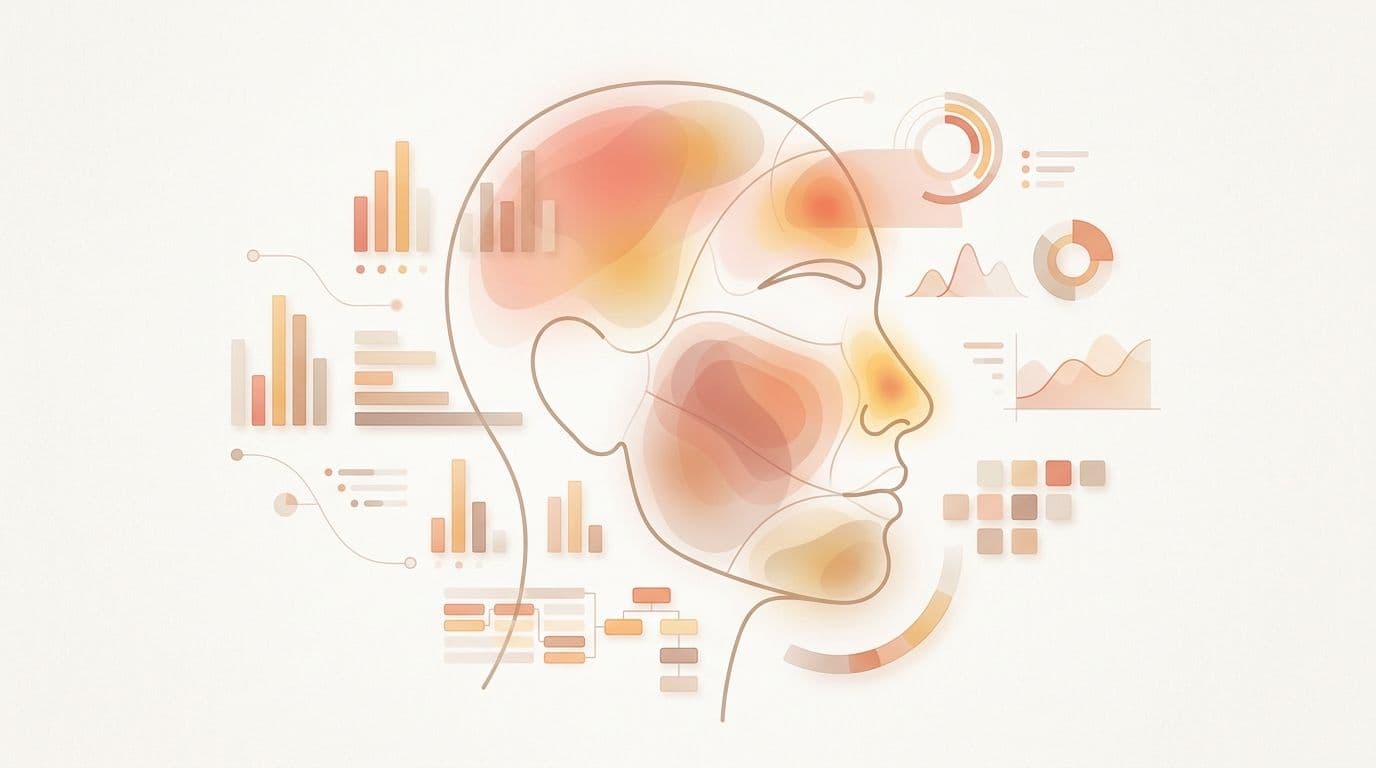
- Forehead: 48%
- Left cheek: 46%
- Right cheek: 46%
- Chin: 25%
- Nose: 21%
The forehead leads, the cheeks are nearly tied with it, and — surprising given how much attention "hormonal chin acne" gets — the chin shows breakouts in only a quarter of scans.
Also worth noting: the cheeks are almost perfectly symmetrical, at 46% each. The popular claim that your phone-call cheek or pillow side breaks out dramatically more doesn't show up at population level. If your breakouts are strongly one-sided, that's a personal pattern worth tracking — not a universal rule.
The median scan tells a younger story than you'd expect
The median AI-estimated skin age across the corpus is 24. Acne tracking isn't a teenage concern: the bulk of people actively scanning and tracking their skin are in their twenties, dealing with adult acne the folklore wasn't written for.
And this data isn't drawn from one demographic: scans span all six Fitzpatrick skin types, with types IV and V — medium to deep skin tones — making up 57% of the corpus. Most published acne imagery research skews pale; this sample doesn't.
What this means for your routine
- Zone-by-zone beats whole-face. With forehead and cheeks affected in nearly half of faces but chin in only a quarter, one averaged "acne score" hides where your problem actually lives. Track zones separately.
- The folklore is a starting hypothesis, not a diagnosis. Population data can't tell you whether YOUR chin breakouts are hormonal. Three weeks of daily scans correlated against your cycle, sleep, or product changes can get you much closer.
- Progress is invisible day to day. A severity score moving from 35 to 28 over six weeks is real progress your mirror will not show you. That's the entire reason we built scan history.
Methodology: figures are aggregated from 11,379 anonymized SkinPal AI scans (September 2025 – March 2026) that completed full analysis. No individual user data is included. AI severity scores measure visible lesions and are not a medical assessment.
Related Topics
Want to see these changes on your own face instead of reading about them? SkinPal's free AI skin analysis reads eight skin metrics from a single selfie and tracks how they change over time. Learn more about the SkinPal AI app.
About the Author
Indra Poudel Founder of SkinPal AI and Pypple Technology LLC.

